Mega projects — think nuclear refurbishments, high-speed rail, Olympic venues, or multi-billion-dollar energy infrastructure — are the Olympics of project delivery.
They can take a decade or more, involve thousands of stakeholders across dozens of organizations, and operate under political, environmental, and commercial scrutiny. The price tags often rival the GDP of small nations.
And yet… most don’t meet the goals set at the start.
Ben Flyvbjerg, Oxford professor and one of the world’s most cited experts on mega projects, found that over 90% overrun their budget, miss schedule targets, or underdeliver on promised scope — sometimes all three.
But there’s another side to the story. A small but powerful minority of mega projects not only meet their targets but also become industry benchmarks for delivery excellence.
The question is: What separates the 90% from the 10%?
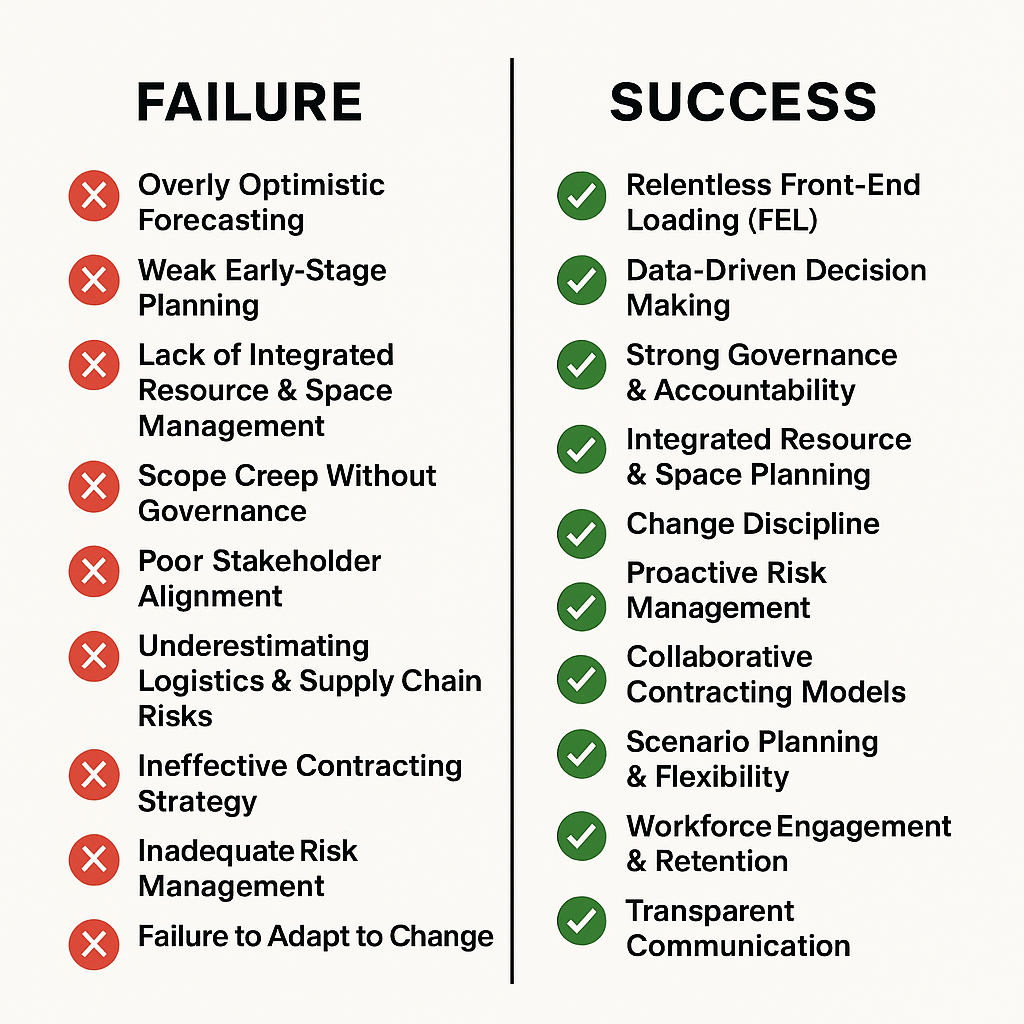
Top 10 Reasons Mega Projects Fail (With Real Examples)
1. Overly Optimistic Forecasting
The Problem: Cost, schedule, and complexity are underestimated — often driven by optimism bias, political promises, or competition for funding.
Example: The Sydney Opera House was forecast at $7M over 4 years. It took 14 years and $102M.
Lesson: Independent peer reviews, reference class forecasting, and contingency planning are essential before commitments are made.
2. Weak Early-Stage Planning
The Problem: Breaking ground before scope, sequencing, logistics, and procurement plans are fully locked in.
Example: Berlin Brandenburg Airport began construction with incomplete design packages, leading to more than a decade of delay.
Lesson: Industry leaders in front-end loading (FEL) spend 25–30% of the total project timeline before a shovel hits the ground.
3. Lack of Integrated Resource & Space Management
The Problem: Workers, cranes, and materials are ready — but can’t access the workface due to poor spatial coordination.
Example: Large-scale refinery builds have seen $10M+ in lost productivity when cranes sat idle waiting for cleared access.
Lesson: Treat work zones, laydown areas, and access routes as constrained resources in scheduling systems like P6.
4. Scope Creep Without Governance
The Problem: Incremental design tweaks snowball without structured cost and schedule impact assessments.
Example: Boston’s Big Dig exploded from $2.8B to nearly $15B, largely from ungoverned scope changes.
Lesson: Change Control Boards (CCBs) must be empowered to say “no” without political fallout.
5. Poor Stakeholder Alignment
The Problem: Differing priorities between owners, EPC contractors, regulators, financiers, and the public lead to paralysis.
Example: The UK’s HS2 rail has been hamstrung by shifting political agendas and community pushback.
Lesson: Build alignment on success metrics and decision rights before launch — and maintain it through structured engagement.
6. Underestimating Logistics & Supply Chain Risks
The Problem: Critical-path materials delayed by shortages, customs, or insolvency.
Example: Alberta oil sands projects saw 12–18 month delays when prefabricated modules couldn’t be shipped on time.
Lesson: Secure long-lead items early, diversify sourcing, and build redundancy into the supply chain.
7. Ineffective Contracting Strategy
The Problem: Misaligned incentives encourage claims management instead of collaboration.
Example: Turnkey EPC projects in the Middle East have collapsed when contractors refused to absorb unrealistic risk.
Lesson: Contracting models must balance risk allocation with shared incentives for success.
8. Inadequate Risk Management
The Problem: Risks logged once and never updated — until they become issues.
Example: Fukushima Daiichi’s sea wall was built for smaller tsunamis than historical records suggested.
Lesson: Treat risk management as dynamic, updating weekly with measurable mitigation actions.
9. Failure to Adapt to Change
The Problem: Projects rigidly follow outdated plans despite new market realities or technological advances.
Example: Large telecom builds have been completed using obsolete technology because teams resisted redesign.
Lesson: Embed agility into governance, allowing pivots without losing overall control.
10. Weak Project Controls & Reporting
The Problem: Leaders make decisions on outdated or incomplete data.
Example: Some infrastructure projects receive status reports 6–8 weeks behind reality — too late to recover lost ground.
Lesson: Implement integrated, real-time project controls to inform decisions with current facts, not historical snapshots.
What the Most Successful Mega Projects Do Differently
When mega projects succeed, it’s not luck. They apply discipline and foresight in a few critical areas:
Relentless Front-End Loading (FEL) – Heavy investment in early planning, scenario modelling, and alignment.
Data-Driven Decision Making – Real-time dashboards for cost, schedule, productivity, and risk.
Strong Governance & Accountability – Clear roles, escalation paths, and empowered leaders.
Integrated Resource & Space Planning – Coordinating people, equipment, and materials like air traffic control.
Change Discipline – Evaluating scope changes for impact before approval.
Proactive Risk Management – Continuous monitoring and mitigation.
Collaborative Contracting – Incentives tied to joint outcomes, not individual gain.
Scenario Planning & Flexibility – Preparedness for regulatory, market, and tech shifts.
Workforce Engagement – Prioritizing safety, morale, and retention.
Transparent Communication – Honest, consistent updates for all stakeholders.
Bottom Line:
Mega projects fail when ambition outpaces discipline. They succeed when leaders treat planning as sacred, risks as evolving, and resources as finite assets to be managed with precision.
Winning in the mega project arena is less about heroics and more about building the systems, culture, and decision-making cadence that can endure years of complexity and still cross the finish line on time, on budget, and at quality.
 Resource Management