Mega projects — whether nuclear refurbishments, energy megaprojects, or national infrastructure — are notorious for cost overruns, schedule slippage, and productivity loss. For decades, project controls existed to report what went wrong.
But that’s changing. Rapidly.
📈 Looking Back: The Journey So Far
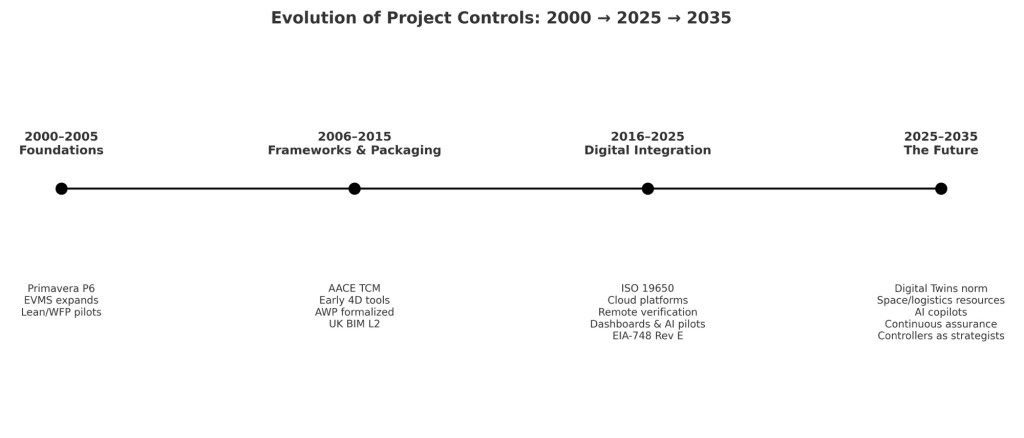
2000s → Schedules in Primavera P6, EVMS compliance, siloed data. 2010s → AWP formalized, BIM mandates, ISO 19650 standards, cloud platforms. 2020s → Pandemic drives remote verification, dashboards, and early AI pilots.
Controls matured from paper reports → digital evidence.
🚀 Looking Forward: 2025–2035
The next decade won’t just tweak the tools — it will redefine the role of project controls entirely.
1. Digital Twins as Standard
Real-time, living models linked to cost, schedule, space, and progress.
2. Space & Logistics as Resources
Outage zones, laydown yards, cranes, scaffolding, and site access treated like labor and cost — centrally managed.
3. AI-Enabled Decision Support
Bots scanning schedules, predictive forecasting, and copilots recommending corrective actions.
4. Continuous Assurance
Governance and regulators expect always-on dashboards tied to validated baselines.
5. The New Role of Controllers
From spreadsheet builders to data strategists and decision enablers.
⚡ Why This Matters
Mega projects are already at the edge of human complexity. Without this evolution, overruns will remain the norm. With it, we can move from reporting after the fact → to steering outcomes in real time.
The organizations that adopt digital twins, AI copilots, and logistics-as-a-service will not just deliver better projects — they’ll set the new industry standard.
👉 Question for you:
How prepared is your organization to move from reporting what happened → to steering what will happen?
💡 What’s the biggest change you’ve seen in project controls in your career?
#ProjectControls #MegaProjects #DigitalTransformation #ConstructionInnovation #AIinConstruction #BIM #AdvancedWorkPackaging
 Resource Management