When people talk about mega-projects—billion-dollar undertakings with thousands of workers—what usually comes to mind are cranes on the skyline, massive concrete pours, or cutting-edge engineering feats. But ask anyone who has lived through a capacity-constrained site, and they’ll tell you the truth: projects succeed or fail not because of blueprints, but because of logistics, space, and resource management.
In other words: your concrete can’t cure, your turbine can’t spin, and your milestones can’t hold—if your people, tools, and materials can’t move, fit, or flow.
The Silent Cost Driver: Whitespace and Capacity Constraints
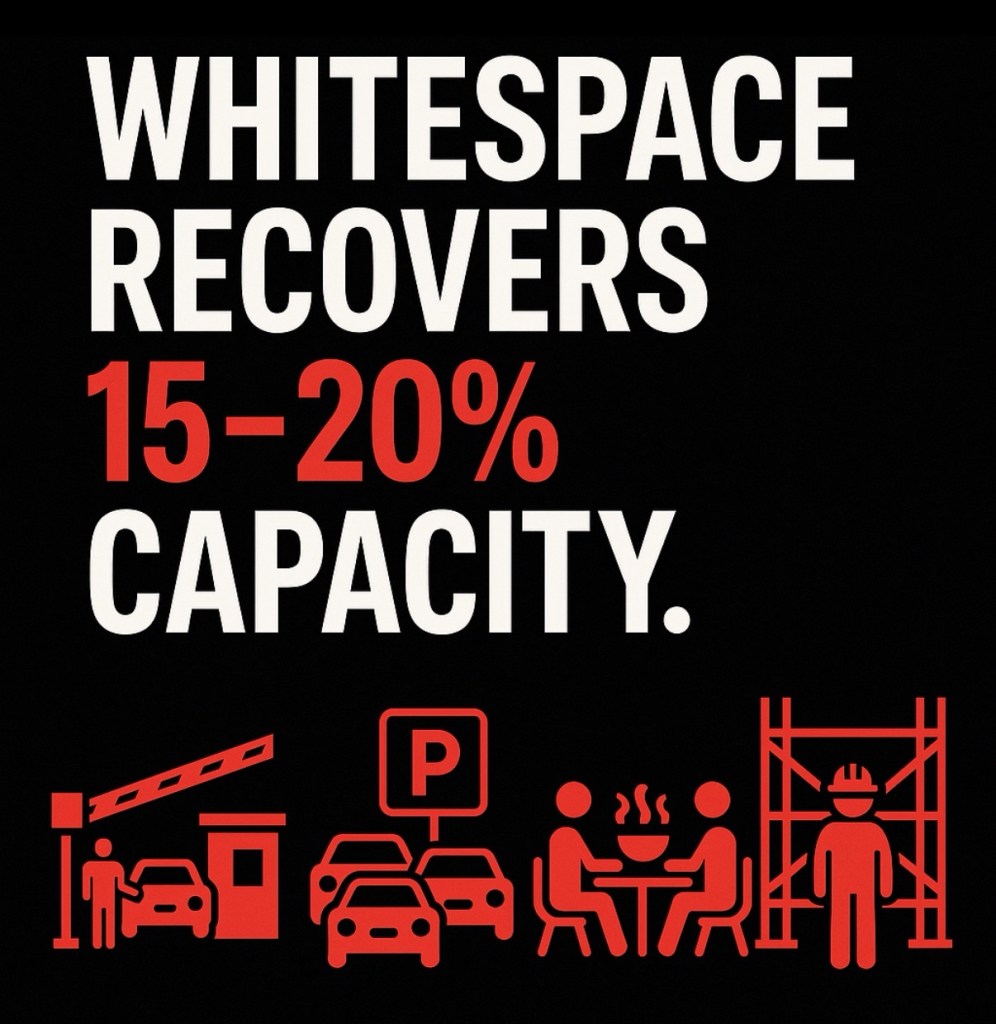
On a mega-project with thousands of trades, every minute counts. Yet day after day, hours vanish into what insiders call “whitespace”:
Waiting in traffic outside a congested gate. Searching for parking in an overfull lot. Lining up for scarce lunchroom seats. Standing idle because a scaffold isn’t built, or because another trade hasn’t released the workfront.
These aren’t minor irritants. They’re structural drains on productivity, often bleeding 15–20% of total paid hours. That’s tens of millions of dollars in lost capacity—hidden in plain sight.
Logistics: The Artery System of a Mega-Project
Think of a mega-project as a living organism. Logistics is the bloodstream that carries lifeblood—people, equipment, and materials—to the right places at the right time.
Without robust logistics:
Deliveries back up at gates, blocking critical equipment. Trades arrive late or exhausted after spending an hour just getting inside. Materials pile up in the wrong place, while the right crews stand idle.
With optimized logistics:
Gate cycle times are predictable, under 15 minutes. Flow paths for people and materials are mapped and managed. Shared services (like cranes, transport, or temporary works equipment) are coordinated at a portfolio level, not left to chance.
The difference is night and day—and it’s the difference between a project that hits milestones and one that hemorrhages hours.
Space: The Invisible Battlefield
Space on a constrained site is more valuable than steel or concrete. It determines whether trades can actually work, or whether they’re forced into costly stop-start cycles.
Laydown yards decide whether material handling is efficient or chaotic. Lunchrooms and amenities determine whether 2,500 workers return to work on time—or 45 minutes late. Workfront availability governs whether trades flow sequentially—or spend weeks in delay because areas weren’t released on time.
Leaders often underestimate this battlefield, yet it is the number-one risk to predictable performance on high-density, urban, or high-security mega-projects.
Resources: Unlocking Hidden Capacity
Too often, “resources” are reduced to headcount. But resource management is about far more than hiring bodies. It’s about recovering the hours you already pay for by eliminating systemic waste.
That means:
Coordinating shared services so a crane isn’t booked by three projects at once. Aligning schedules so dependent trades don’t collide. Tracking crew productive hours, and raising the baseline from 55% to 70%—a gain worth thousands of hours with the same labor force.
Whitespace management doesn’t add resources—it recovers them. On a mega-project, that’s the equivalent of unlocking an extra workforce without spending a single additional dollar.
The Executive Imperative: Treat Logistics as Core Business
Here’s the hard truth: logistics, space, and resource coordination are often treated as afterthoughts—“support functions” managed reactively. Yet they are the core business of mega-project delivery.
Ignore them, and the project will drown in cost overruns, blown schedules, and frustrated workers. Prioritize them, and you create the conditions for everything else—engineering brilliance, safety excellence, and on-time delivery—to thrive.
The Call to Action
If you are leading or sponsoring a capacity-constrained mega-project, you must ask yourself:
Who owns logistics and whitespace management on your site? Do you measure gate cycle times, crew productive hours, or space utilization with the same rigor you measure cost and schedule? Have you built a dedicated logistics and resource management team, empowered at the same level as project controls or construction management?
Because in the end, success on a mega-project is not about how well you can build—it’s about how well you can move, fit, and flow.
👉 Mega-projects don’t fail because of engineering. They fail because of logistics, space, and resources. Treat them as the true critical path—and you’ll deliver what others can’t.
 Resource Management