What Sukiyabashi Jiro can teach us about the waste hidden in green dashboards
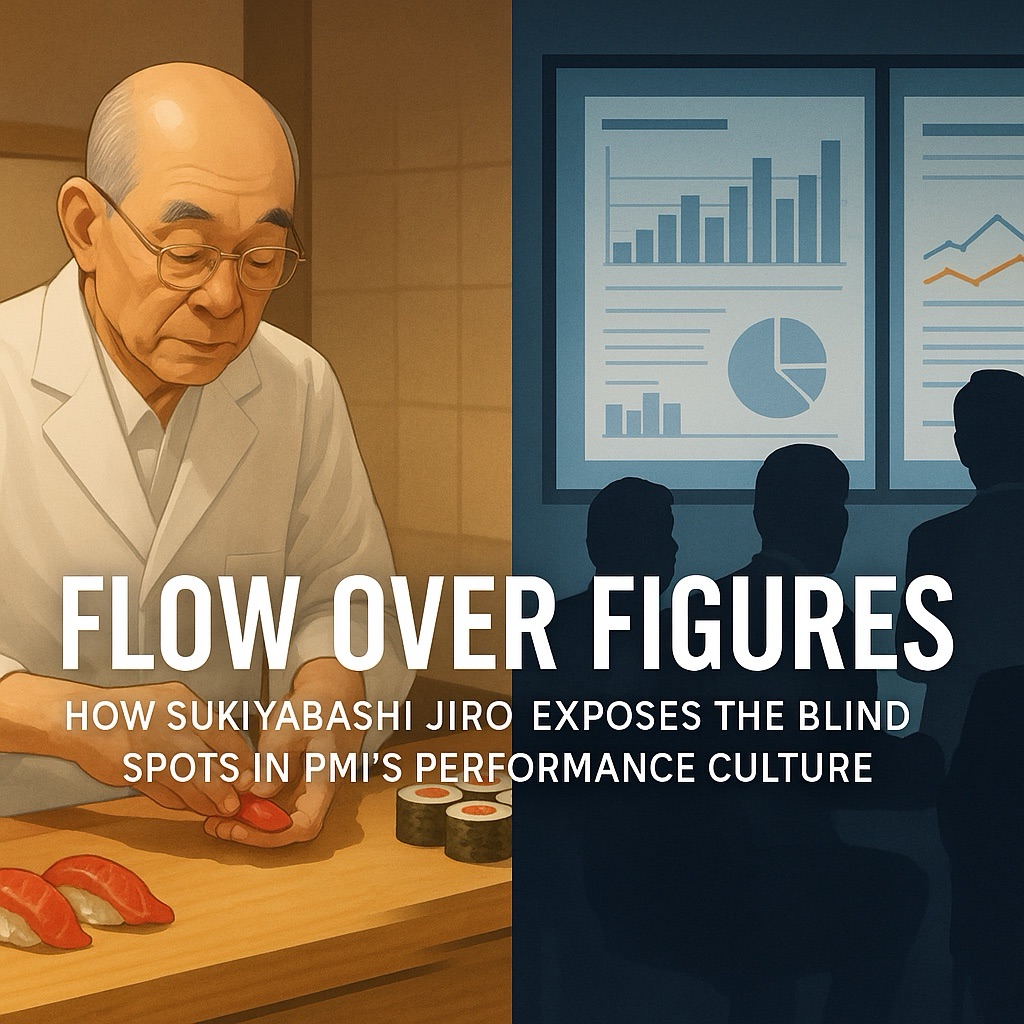
The Story of Jiro
In a tiny, quiet basement in Ginza, Tokyo, sits a ten-seat sushi restaurant that changed the world’s idea of mastery: Sukiyabashi Jiro.
Its owner, Jiro Ono, has been making sushi for over 70 years. Every day, he arrives before dawn. He massages octopus by hand for 45 minutes to soften it. He adjusts the rice temperature by a single degree depending on humidity. He watches every guest’s posture and pace, serving each piece at the exact moment it will be perfect.
There are no menus, no meetings, no committees—only discipline, awareness, and respect for the process.
Michelin stars, global fame, and documentaries followed. Yet Jiro still says,
“I continue to climb the ladder of perfection, but I will never reach the top.”
He is relentless in one thing: continuous improvement.
Every day, he seeks alignment—between fish, rice, air, and time.
Across Town: The Project Office
Thousands of miles away, in corporate boardrooms and government project offices, teams gather around dashboards.
They review KPIs.
They analyze CPI, SPI, and EVM trends.
They talk about continuous improvement.
But the data glows green while the work bleeds red.
Crews wait for access.
Cranes sit idle.
Trades are mis-sequenced.
The system declares success—but the site tells another story.
This is where traditional project management fails:
PMI’s metrics measure cost and schedule, not resource flow or utilization.
They celebrate performance against plan, not performance against potential.
What Jiro Would See
If Jiro managed a project, he wouldn’t start with SPI or CPI.
He’d start with rhythm.
He’d listen to the crews the way he listens to the rice—feeling where energy is wasted, where timing is off.
He’d notice that scaffolds block the electricians.
That a rigger waits for a permit longer than he works.
That a welder walks half a mile to find tools each morning.
To Jiro, that’s spoilage.
To PMI dashboards, it’s invisible.
The Core Problem
Project controls were built around budget and schedule, not flow and utilization.
They reward compliance with a plan—even when that plan was wrong from the start.
Meanwhile, resource efficiency—the real driver of productivity and cost performance—is left unmeasured.
This is why projects “on budget” still fall behind, and “on schedule” teams still feel exhausted.
We’ve confused reporting with refinement.
We’ve built systems that manage effort, not optimize it.
The Resource Manager’s Realization
A young resource manager visits Sukiyabashi Jiro after a long week of progress reviews.
He watches Jiro serve a guest—precisely timed, perfectly composed.
He asks, “How do you know when to serve it?”
Jiro smiles:
“The fish tells me. The rice tells me. The air tells me.
I listen.”
That night, the manager realizes—his dashboards don’t listen.
They record what happened; they don’t feel what’s happening.
They don’t tell him when his resources are drifting out of sync.
He stops managing utilization by percentages and starts mapping flow:
where resources get trapped, where space becomes the constraint, where handoffs die.
The New Mindset
Resource management, like sushi, is about timing and alignment, not just measurement.
It’s about respect—for people, for process, and for the rhythm of work.
Continuous improvement isn’t a program; it’s a posture.
PMI measures progress.
Jiro measures presence.
The day project controls learn to see like Jiro—to sense flow, balance capacity, and respect the craft of coordination—is the day we rediscover what continuous improvement really means.
Closing Reflection
If Jiro were running your project, he wouldn’t ask,
“Are we on schedule?”
He’d ask,
“Are we in sync?”
Because true excellence isn’t about hitting milestones.
It’s about the quiet, disciplined act of keeping the rhythm alive.
 Resource Management