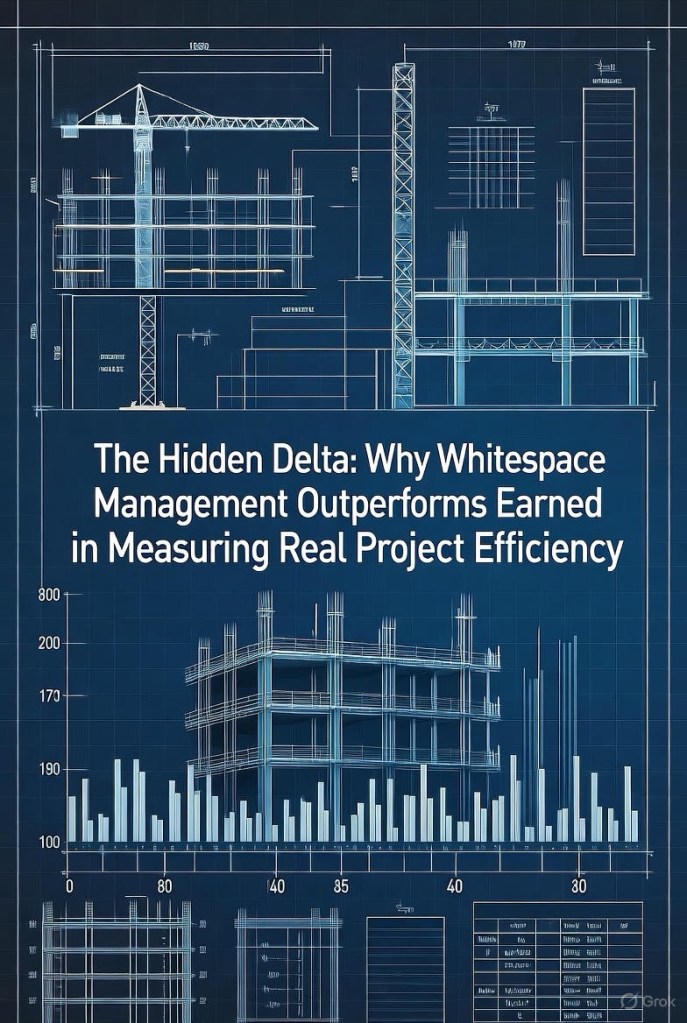
Most mega-projects swear by Earned Value (EV) as the gold standard for performance tracking.
Yet EV only answers one question: Are we earning what we planned?
It doesn’t ask the more important one:
Can the site actually execute the plan tomorrow morning?
That’s where Whitespace Management™ changes everything.
1. A Cost System That Forgot About Physics
Every week, project teams obsess over CPI, SPI, and EAC curves.
But EV assumes that schedules exist in limitless space — that gates, laydowns, and cranes never clash.
Anyone who’s walked a crowded turbine hall knows otherwise.
Whitespace Management measures the physical capacity of a site — space, services, logistics, and labor — to see if the plan is truly executable.
2. The Earned Value Trap
EV tracks three variables — Planned Value, Earned Value, and Actual Cost —
then produces comforting ratios (CPI, SPI).
But EV is lagging and economically blind:
Lagging, because it only shows performance after the loss occurs. Blind, because it treats every workspace as equal, ignoring congestion, interference, and access.
EV reports variance; Whitespace reveals causality.
3. Defining Whitespace
Every project operates inside a Resource Supply Envelope — the real-world limit of what the site can handle.
Whitespace (Δ) = Resource Supply – Resource Demand (from P6)
A positive Δ means opportunity (available capacity).
A negative Δ means congestion (inefficiency waiting to happen).
Whitespace makes that invisible delta visible.
4. Measuring the Delta in P6
Primavera P6 already holds the data — it just needs to be coded correctly:
Tag activities by Area Code, Trade, and Shared Service. Overlay actual supply (crews, gates, cranes). Calculate the Whitespace Index to forecast over- or under-capacity.
When demand exceeds supply, you get interference.
When supply exceeds demand, you gain productive room to move.
5. The Three Lenses of Whitespace
Resource Whitespace: planned trade demand vs available headcount. Spatial Whitespace: crew density per workface or zone. Shared-Service Whitespace: cranes, lifts, and logistics throughput.
Each lens quantifies a different constraint — all three define the project’s true flow potential.
6. Turning Data into Foresight
Once Whitespace indices are known:
Planners smooth peaks. Supervisors relocate crews before congestion hits. Logistics retimes deliveries. Executives validate if forecasted progress is even possible.
Whitespace transforms scheduling from theoretical sequence charts into predictive flow control.
7. The Economics of Congestion
Congestion costs explode non-linearly.
Every 10 % over optimal crew density erodes 3–5 % productivity.
On a $1 B project with 3 M labor hours, a 15 % loss equals 450,000 wasted hours — roughly $25–30 M.
Whitespace forecasting prevents that without adding a single worker.
8. Integrating with Earned Value
Whitespace doesn’t replace EV — it makes it honest.
EVR = EV × Whitespace Health Index
If EV forecasts $10 M earned but Whitespace Health = 0.82, the realized value is $8.2 M.
EVR converts EV from reporting to control.
9. Governance and Decision Rhythm
Daily Resource Huddles: review yesterday’s hits/misses. Weekly Whitespace Board: address top-10 congestion zones. Monthly EV Review: credit progress only when Whitespace Health > 0.9.
Physical feasibility and financial reporting finally meet.
10. Implementation Roadmap (90 Days to Flow)
Phase
Focus
Outcome
0–30 Days – Stabilize
Tag activities with area/trade codes
Foundational alignment
31–60 Days – Optimize
Launch forecasts, enforce density limits
Early de-conflict wins
61–90 Days – Scale
Integrate dashboards into EV reviews
Continuous predictive control
Typical results:
+10–20 % Time-on-Tools | 25–40 % less waiting | Zero extra cost
11. From Busyness to Flow
Whitespace thinking replaces more labor with aligned labor.
Crews coordinate, planners stay within capacity, supervisors manage flow instead of firefighting.
The site breathes again.
12. The Whitespace Delta Curve
Picture two lines:
Demand Curve (P6) rising with scheduled work. Supply Curve flat at true capacity.
The red gap between them — the Whitespace Delta — is your invisible cost driver.
Shrink the gap; recover time, space, and money.
13. Why This Matters Now
In the digital-twin era, projects can’t “report their way to control.”
Predictive capacity management is now the real competitive edge.
Whitespace turns static schedules into living resource ecosystems.
14. The Future: Resource Intelligence
Whitespace Management™ sits inside the Resource Intelligence Loop™ —
Observe → Analyze → Adjust → Optimize.
Integrated with EV, it forms a dual-engine model:
Loop
Metric
Feedback Speed
Outcome
Financial
CPI / SPI
Monthly
Economic Efficiency
Physical
Whitespace Index
Daily
Flow Efficiency
Together they create Integrated Resource Intelligence™ — predictive, real-time, and constraint-aware.
15. Executive Takeaway
Earned Value measures financial efficiency.
Whitespace Management measures physical efficiency.
The delta between them determines whether your project bleeds or excels.
Measure that delta, manage that flow,
and you unlock 15–20 % more productive hours —
without a single extra dollar spent.
CRU – Construction Resource Utilization
Whitespace Management Framework™ v1.0
 Resource Management