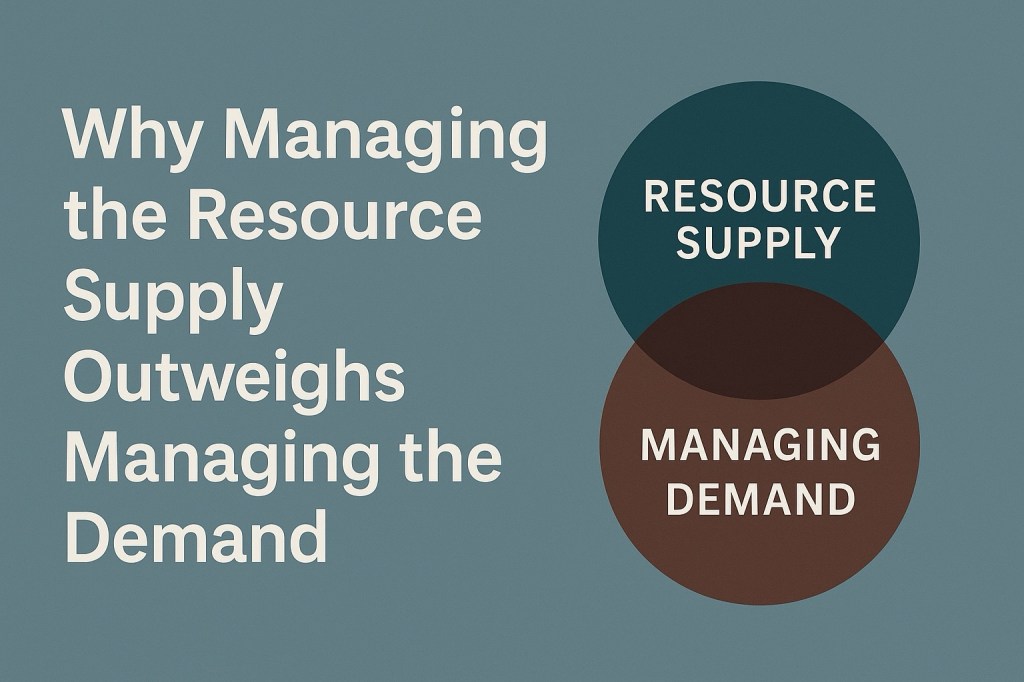
“You can’t earn what you haven’t enabled.”
1. The Hidden Assumption in Project Management
Project controls are built on demand.
Schedules tell us what must be done, when, and by whom. Cost systems track how much we’ve spent relative to what we’ve earned.
But there’s a fatal assumption hiding beneath all that structure:
that the physical supply of space, access, and logistics will somehow match the plan.
The Project Management Institute (PMI) and its PMBOK® frameworks gave us remarkable structure for scope, cost, and schedule. Yet they treat resources—people, space, and shared services—as supporting actors, not as the physical constraints that determine whether work can actually flow.
2. The Demand-Side Illusion
Demand-centric control assumes infinite elasticity of resources.
Schedules expand, forecasts adjust, reports are updated — but the physical reality doesn’t care.
You can’t weld faster than your power supply allows.
You can’t accelerate concrete curing by updating the Gantt chart.
And you can’t fit 60 trades into a lunchroom built for 20.
So even as demand metrics (like SPI and CPI) tell us how “behind” we are, they reveal nothing about why.
3. PMI’s Framework Is Complete — But Not Whole
PMI’s Earned Value Management (EVM) and Scheduling Standards measure variance against planned output — not against supply readiness.
They ask, “Did we do the work?”
They never ask, “Was the work physically possible at that time and place?”
Even PMI’s Resource Management domain tracks assignments and roles but not spatial density, logistics flow, or concurrent workfront limits — the real bottlenecks of productivity.
This is why global studies show 80% of megaprojects overrun — not because of bad planning, but because of invisible constraints on supply.
4. Physics Always Wins
Every jobsite, from a nuclear plant to a hospital build, operates under the laws of physics.
When capacity (space, gates, cranes, lifts, laydowns) is exceeded, work slows, safety risks climb, and costs rise exponentially.
Managing demand is abstract.
Managing supply is physical.
Lean Construction and the Theory of Constraints teach us: flow is everything. Flow isn’t governed by the task list — it’s governed by the tightest constraint in the system.
So managing supply first—ensuring enabling works, workfronts, and access are ready—naturally self-balances demand. It prevents over-stacking, reduces idle labor, and keeps field rhythm steady.
5. From Earned Value to Enabled Value
Traditional EVM asks, “How much value did we earn for the work performed?”
But what if the right question is, “How much value did we enable to be earned?”
Managing resource supply turns project control from a financial exercise into an operational one.
It introduces new metrics:
Resource Readiness Index (RRI): % of planned workfronts physically ready for execution. Utilization Density: the degree to which workspace/time is actively productive vs. idle. Flow Efficiency Ratio: productive time ÷ total occupied time per resource.
These tell you the system’s capacity to deliver value, not just how much of the plan you executed.
6. The Shift to Resource Intelligence
When supply is modeled digitally — spatial zones, crane capacity, gate throughput, and shared services — you stop managing on assumptions.
You manage on physics.
Tools like Whitespace Management™, Resource Intelligence Loop™, and Shared Service Optimization Matrix™ (developed within the CRU™ framework) bring visibility to this invisible layer. They make capacity constraints measurable, predictable, and schedulable.
This transforms a project from “hope and react” to “forecast and flow.”
7. The Organizational Payoff
Projects that manage supply ahead of demand consistently show:
✅ 20–30% productivity uplift
✅ Reduced crew idle time
✅ Smoother logistics coordination
✅ Unified “One Site, One Team” culture
By synchronizing the physical system first, every downstream metric — CPI, SPI, EAC — becomes stable by default. You’re not forcing progress; you’re enabling it.
8. The New Order of Control
PMI taught us how to plan work.
The next era demands we plan for work to fit.
Demand management measures intention. Supply management governs reality.
When both are integrated, project control evolves into a living operating system — one that measures flow, not just progress.
 Resource Management