Let’s stop pretending.
Most organizations don’t have Project Controls.
They have Project Reporting.
A group of people who spend 70% of their time:
Rebuilding spreadsheets Chasing data nobody trusts Reconciling numbers no one uses Formatting PowerPoints for executives who skim them Updating schedules leadership ignores Logging risk items that never get mitigated Publishing reports that confirm what everyone already knew
And the industry has the audacity to call this “control.”
It’s not control.
It’s administration.
If your job is to sanitize the past, you are not influencing the future.
You are managing optics, not outcomes.
The Core Problem: Most Leaders Don’t Want the Truth, They Want Comfort
Here’s the real political reality:
Leaders want green dashboards because green dashboards make them look successful. Executives cling to last year’s success story because it’s easier than facing today’s complexity. PMOs default to templates over judgment. Vendors inflate PMT headcounts and nobody challenges them. Schedules are built to please, not to execute. Planners check logic, but never physical feasibility. Risk registers become graveyards for issues no one wants to confront. Capacity constraints are treated as a rounding error.
And then everyone acts surprised when the project slips.
Shock is not an excuse.
It’s evidence of denial.
The Harsh Reality: Complex Sites Don’t Care About Your Intentions
On a nuclear site—or any constrained, high-risk environment—
the laws of capacity, flow, and physics run the project.
Not dashboards.
Not optimism.
Not executive talking points.
Not “lessons learned.”
Not PowerPoints with arrows pointing up and to the right.
If the building is full, nothing moves.
If the gate is backed up, productivity collapses.
If PMT grows faster than DFL, indirects spike.
If 40+ vendor teams load manpower without sharing data, the site becomes gridlock.
If planning ignores white-space constraints, your schedule is a fantasy novel.
If material cannot physically flow through the station, your milestones are an illusion.
Project Controls that doesn’t integrate space, access, logistics, and capacity is performing theater, not intelligence.
What Real, Future-Focused Project Controls Actually Looks Like
Future-focused Project Controls does not ask permission to speak hard truths.
It forces clarity.
It says:
“Your crew plan doesn’t fit inside this station.”
“Your PMT ratio is unsustainable and wasteful.”
“Your shift plan collapses the gate at 7:00 AM.”
“This outage sequence violates physical reality.”
“This vendor’s load board doesn’t match infrastructure capacity.”
“Your rosy forecast is mathematically impossible.”
“We’re not under control. Here’s the evidence.”
If a Project Controls team can’t do this, they are working for the project—but not protecting it.
Brutal Truth: Most Projects Fail Because Project Controls Was Neutered Politically
Not because they didn’t have tools.
Not because they didn’t have data.
Not because they didn’t have smart people.
Projects fail because the organization:
Ignored early warnings Rewarded optimism Punished honesty Downplayed constraints Avoided hard choices Valued pace over clarity Protected egos over outcomes Confused reporting with control
Project Controls didn’t fail.
Leadership did.
What CRU™ Stands For: The Shift Everyone Else Avoids
CRU™ is built on a simple, uncomfortable truth:
If you can’t see the constraints, you can’t control the project.
And constraints exist everywhere:
Space Time Access Logistics Parking Breakrooms Shared services PMT/DFL ratios White-space Resources Material flow Shift patterns Capacity of the building itself
Most organizations pretend these constraints don’t matter.
CRU™ exposes them.
Integrates them.
Plans around them.
And turns them into a strategic advantage.
This is what future-focused project intelligence looks like.
This is the evolution Project Controls avoided for too long.
Closing Line — The Knife Twist
If all your Project Controls team does is publish reports, you don’t have a project intelligence function.
You have a record-keeping department documenting the slow-motion failure.
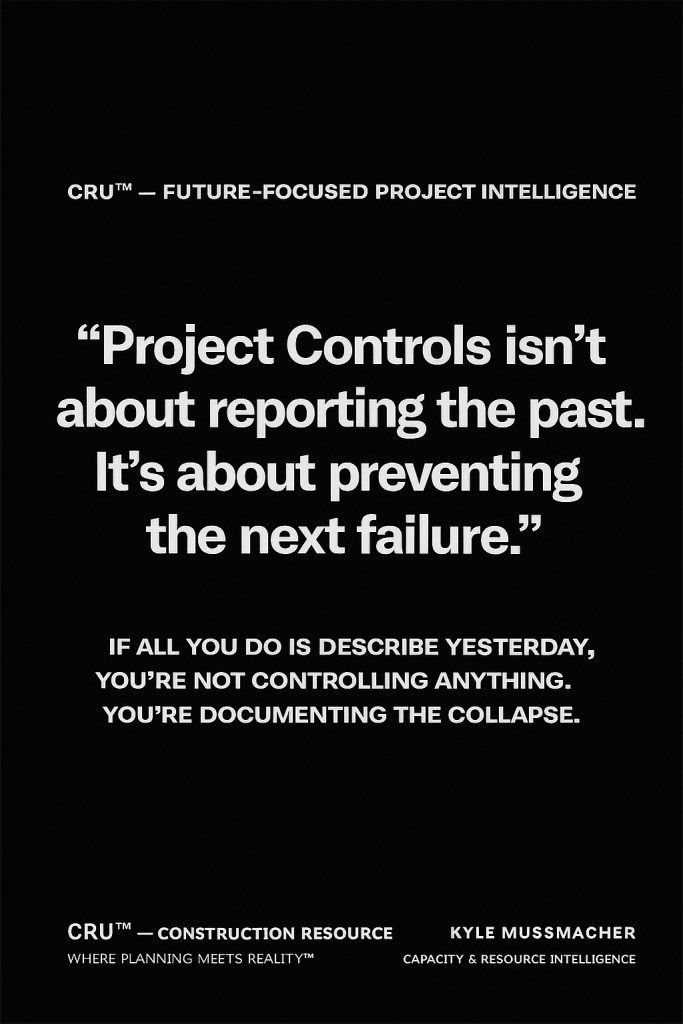
Real Project Controls doesn’t report the past.
It prevents the future from becoming a disaster.
 Resource Management