Why Mega Projects Keep Slipping Even When the Schedule Looks “Green”
In every major project I’ve been part of — nuclear, infrastructure, urban, industrial — the same pattern appears over and over:
Projects don’t fail because people can’t plan.
Projects fail because the schedule is allowed to ignore capacity.
We spend enormous effort building logic ties, levelling work sequences, and polishing dashboards. But none of that protects a project when the site itself has hard physical, logistical, and operational limits that the schedule was never built to respect.
You can have perfect logic…
You can have perfect sequencing…
You can have perfect reporting…
And still walk straight into predictable chaos the moment capacity limits are exceeded.
The Blind Spot No One Talks About
Most schedules assume an ideal world:
Unlimited workspace Unlimited crew absorption Unlimited PMT bandwidth Unlimited gate throughput Unlimited laydown and docking capacity Unlimited lifting windows Unlimited oversight and support services
But actual sites — especially regulated, dense, or security-controlled ones — operate under finite constraints that do not bend just because the schedule needs them to.
And when the schedule and reality diverge, reality wins every time.
Where Projects Actually Break
Projects rarely break because a predecessor relationship was wrong.
They break because:
An area is physically overloaded. A building exceeds PMT fire-code limits. Gate throughput cannot support the headcount spike. Logistics can’t move materials fast enough to support planned workfronts. Oversight groups (QA, RP, engineering support) become choke points. Lunchrooms, change rooms, and parking collapse under load.
None of these show up in a traditional schedule —
but they determine whether the plan can actually be executed.
This is why teams often look “ready” on paper…
and then immediately slip once boots hit the ground.
The Schedule Isn’t the Truth — Capacity Is
This is the uncomfortable part:
A schedule can be manipulated.
Capacity cannot.
You can shift logic, re-baseline, stretch durations, and show recovery curves.
But you cannot stretch parking by 500 stalls.
You cannot fit 250 people into a 100-person area.
You cannot push 1,800 workers through a gate designed for 1,200.
You cannot ask logistics to move double the material with the same dock and crane profile.
Reality doesn’t negotiate.
Capacity doesn’t care about narrative.
This is why the field always exposes the truth first.
The Next Evolution: Capacity-Driven Scheduling
Mega projects are becoming more complex, denser, and more interconnected than ever.
Traditional scheduling — time-driven, logic-heavy, resource-agnostic — simply isn’t enough anymore.
The next era of project planning requires:
1. Capacity as a planning object
Area codes, logistics demand, PMT/craft load, throughput limits.
2. Hard thresholds
Not suggestions — non-negotiable ceilings tied to safety, compliance, and flow.
3. Supply-vs-demand modeling
If the work demands more than the site can supply, the plan is invalid.
4. Integrated logistics intelligence
Gates, docks, cranes, elevators, laydown — all modeled as finite resources.
5. Forward forecasting
12–24 month capacity projections so problems surface upstream, not downstream.
This isn’t about tools.
It’s about mindset.
If capacity becomes the boundary condition, the schedule finally becomes a reliable predictor — not a fictional best-case scenario.
Why This Matters Now
The industry is shifting.
Projects are too big and too integrated to rely on outdated planning philosophies.
Leaders want fewer surprises.
Field teams want fewer battles.
Executives want predictable outcomes.
Stakeholders want confidence, not hope.
We get all of those only when the schedule reflects the world the work is actually happening in.
The Message Behind the Visual
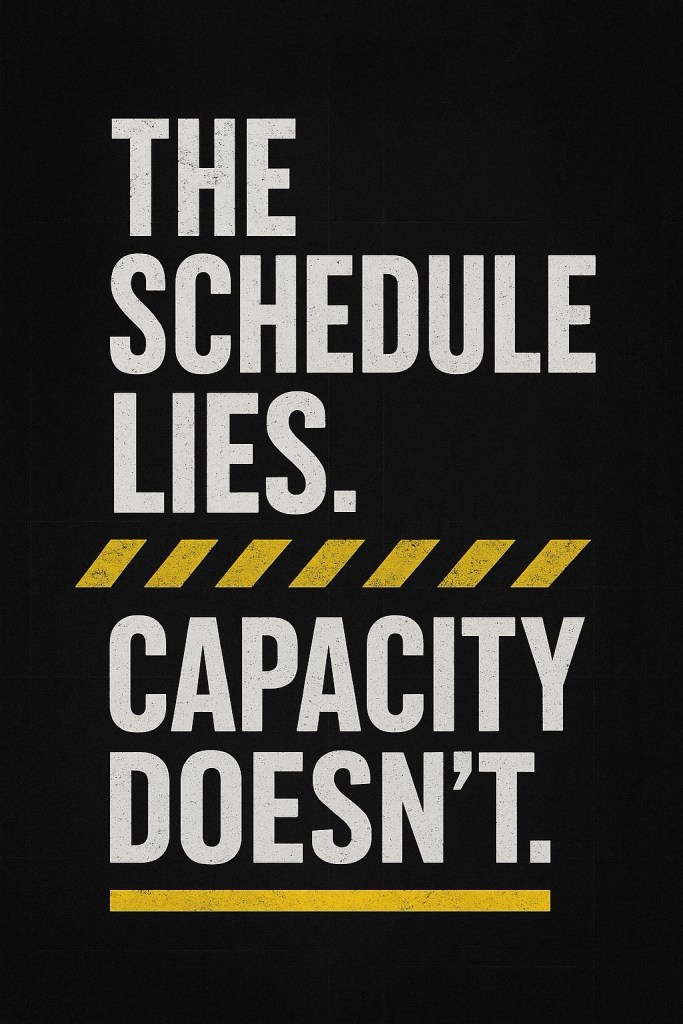
“THE SCHEDULE LIES. CAPACITY DOESN’T.” isn’t a criticism.
It’s a wake-up call.
A reminder that truth is found in constraints — not in optimism.
A reminder that physical reality is the ultimate governance model.
A reminder that mega projects succeed when planning stops assuming infinite everything.
Capacity is not a detail.
It is the control point of modern project execution.
 Resource Management