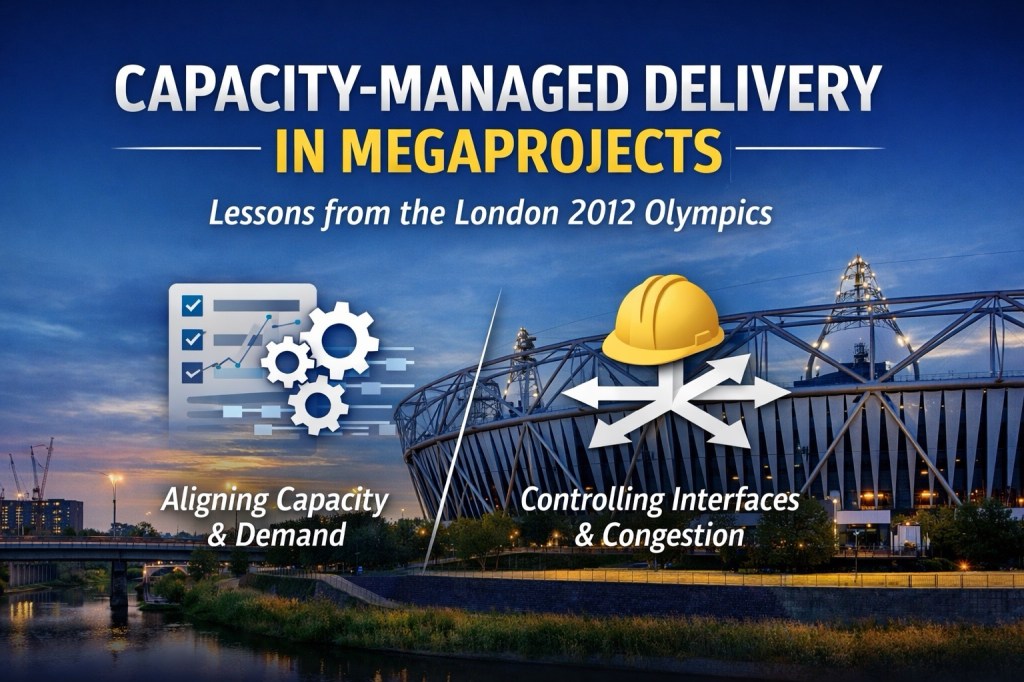
Deep-Dive Case Study of London 2012
Executive Summary
The London 2012 Olympic and Paralympic Games are widely cited as a rare example of a megaproject delivered
successfully against a fixed, immovable deadline. Unlike many large infrastructure programs, London completed
its venues early, transitioned smoothly into operations, and avoided the late-stage crises that frequently
characterize projects of similar scale and complexity.
This paper argues that London 2012 succeeded because physical capacity constraints were explicitly identified,
governed, and enforced across the delivery system. Rather than relying solely on logical schedules, milestones,
and cost controls, the program treated transport capacity, access, interfaces, and operational readiness as
hard limits that shaped planning and execution decisions.
The central conclusion is clear: a schedule can be logically correct and still be physically impossible.
London avoided this trap by aligning demand to system capacity early, continuously, and decisively.
1. Introduction: The Persistent Megaproject Paradox
Despite decades of academic research, professionalization, and methodological advancement, megaprojects
continue to exhibit chronic underperformance. Cost overruns, schedule slippage, productivity erosion, and
late-stage operational failures remain common across transportation, energy, and public infrastructure programs.
A recurring paradox emerges. Detailed integrated schedules are developed and maintained. Earned value and
milestone reporting often remain within acceptable tolerance bands. Workforce plans indicate sufficient labor
availability. And yet, on-site performance deteriorates once execution intensifies.
The disconnect lies not in the absence of planning, but in what is planned and controlled. Most megaprojects
manage logical sequence exceptionally well. They manage physical capacity poorly—or not at all.
Logical sequence and progress metrics fail to represent finite system
capacity, allowing misalignment to remain invisible until congestion manifests on site.
2. Reframing the London 2012 Challenge
London 2012 was not merely a construction program. It was a city-scale transformation executed within one
of the most constrained urban environments in Europe. The Games imposed a fixed and non-negotiable completion
date, dense surroundings, limited transport throughput, heightened security requirements, and extraordinary
levels of public scrutiny.
Under these conditions, traditional delivery questions—such as whether individual venues could be completed
on time—were insufficient. The more consequential question was systemic: could the delivery system absorb
unprecedented, time-peaked demand without destabilization? This reframing fundamentally altered planning
priorities and governance behavior.
3. Capacity as a First-Class Constraint
Many megaprojects implicitly assume that supporting systems—transport networks, access points, staging
areas, and shared infrastructure—will scale as required. These assumptions are rarely explicit, and therefore
rarely tested.
London 2012 rejected this premise. Capacity was treated as a governing variable rather than a background
condition. Transport throughput, site access, interface saturation, and readiness were assumed to be finite,
measurable, prioritizable, and enforceable.
This forced difficult but necessary trade-offs early in the program lifecycle. Activities were sequenced not
only by logical dependency, but by whether the physical system could safely and reliably absorb them. In doing
so, London avoided the compounding congestion effects that plague many late-stage megaprojects.
4. Interfaces as the Primary Source of Failure
Megaprojects rarely fail because a single component underperforms in isolation. Failure most often occurs
at interfaces—where systems, contractors, and phases converge.
These interfaces include points where transport meets site access, where multiple contractors occupy shared
spaces, and where construction overlaps with commissioning and operational readiness. Each interface
introduces dependency, timing sensitivity, and amplification of error.
London recognized interface management as a primary delivery function rather than a coordination afterthought.
Clear integration ownership and decision authority were established to prevent interface conflicts from
escalating into systemic disruption.
5. Deliberate Constraint of Construction Activity
One of the most counterintuitive decisions taken during the London program was the deliberate reduction of
construction intensity as the Games approached. Rather than maximizing visible activity, leadership
prioritized stability, predictability, and readiness.
In many megaprojects, late-stage pressure leads to increased crew density, trade stacking, and congested access,
often justified as necessary for schedule recovery. London recognized that beyond a critical threshold,
additional activity degrades safety, quality, and overall throughput.
Constraining activity in sensitive zones preserved flow, reduced variability, and protected the transition
from construction to operations.
6. Governance Designed for Constraint Management
London’s governance structures were designed not merely to report progress, but to control the delivery
system. Decision-making authority was aligned with system-level risk, escalation paths were clear, and
independent assurance had real influence.
This governance model mattered because capacity constraints require timely and sometimes unpopular decisions.
Without authority, constraints tend to be negotiated away until failure forces recognition under crisis
conditions.
7. Activity Versus Deliverability
London explicitly distinguished between being busy and being capable of delivery. High utilization was
not mistaken for high performance, and visible slack was accepted as a reliability mechanism.
This reframing allowed leadership to prioritize system stability over short-term output, reducing the risk
of late-stage collapse.
8. Why London 2012 Remains the Exception
Despite widespread admiration, the lessons of London 2012 have not been consistently adopted. Many
contemporary megaprojects continue to prioritize schedule logic over physical feasibility, treat capacity as
a risk rather than a constraint, and rely heavily on lagging performance indicators.
The barrier is rarely technical knowledge. It is organizational willingness to enforce limits, say no to
certain demands, and accept visible slack in politically sensitive environments.
9. Conclusion: Respecting Limits as a Leadership Choice
London 2012 did not succeed because it eliminated uncertainty. It succeeded because it acknowledged limits
and built a delivery system around them.
Ignoring constraints does not make them flexible. Until megaprojects treat physical capacity with the same
seriousness as cost and schedule, they will continue to produce plans that are logically correct—and
operationally impossible.
London demonstrated that another approach is possible. The enduring challenge is not learning the lesson,
but having the discipline to apply it.
 Resource Management