After stripping away the illusions of unit rates, logic-only schedules, earned value comfort, and recovered-schedule fiction, one question remains:
If those don’t create control — what does?
The answer is not a new tool.
It is a different operating model.
Control Starts With Accepting Limits
Capacity-managed control begins with a truth most projects avoid:
Not all work can happen at the same time — no matter how logical the plan looks.
Every site has hard limits:
Space Access Supervision Logistics Safety Cognitive load
These are not risks.
They are governing constraints.
Until they are explicitly acknowledged, planning remains aspirational instead of executable.
From Activity Management to System Management
Traditional controls focus on:
Activities completed Percent complete Milestones achieved
Capacity-managed control focuses on:
How many people the system can absorb Where work density becomes destructive Which constraints are currently binding How utilization changes under pressure
The shift is subtle — and profound.
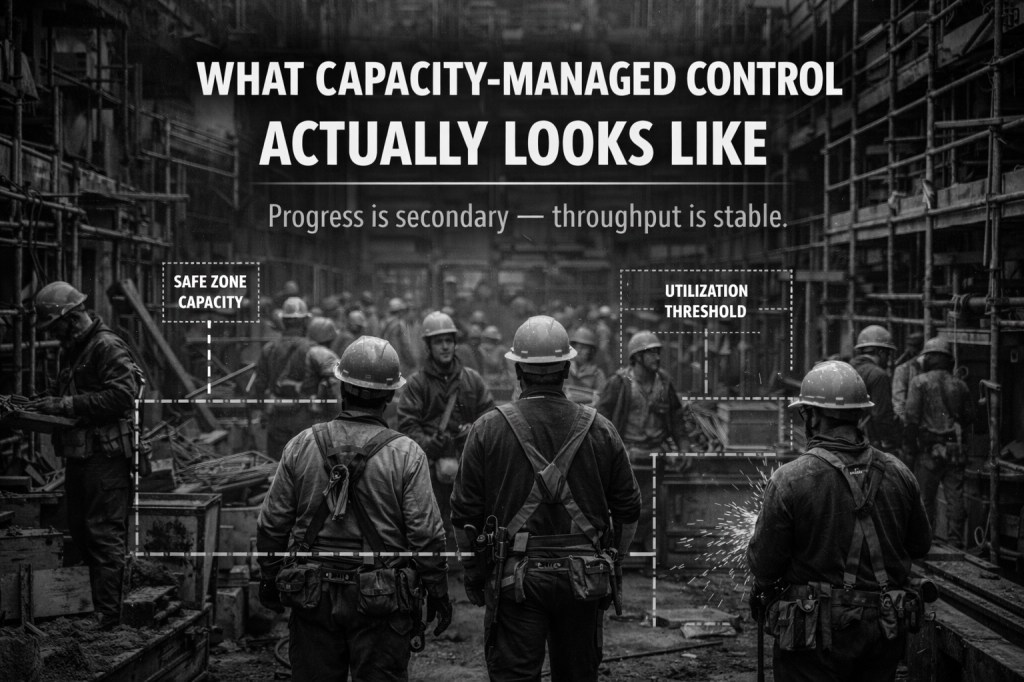
Progress becomes secondary to throughput stability.
Governing Crew Density (Not Just Headcount)
Capacity-managed projects don’t ask:
“How many crews do we need?”
They ask:
“How many crews can this system safely and efficiently support?”
This leads to deliberate decisions:
Limiting parallel work even when scope exists Protecting critical workfaces from trade stacking Sequencing to preserve productivity, not just dates Reducing crews to increase output
Counterintuitive — and consistently effective.
Measuring What Actually Predicts Performance
Instead of waiting for CPI/SPI to turn red, capacity-managed control tracks leading indicators:
Utilization vs. availability Crew density by zone Time lost to interference Standby and waiting accumulation Constraint saturation trends
These signals surface weeks or months before traditional metrics move.
By the time cost variance appears, the decision window is already closed.
Capacity signals reopen it.
Planning Becomes a Constraint Conversation
In a capacity-managed environment, planning meetings change tone.
The question is no longer:
“Can we pull this work left?”
It becomes:
“What breaks if we do?”
Every acceleration has a visible trade-off:
Where efficiency will degrade Which constraints will bind What the cost of pressure will be
This doesn’t slow decisions.
It improves them.
Why Recovery Becomes Rare
When capacity is governed from the start:
Schedules stretch realistically Estimates stop assuming efficiency Crews stop fighting each other Progress becomes predictable
Recovery plans still exist — but they are measured, targeted, and honest.
Not heroic.
Not theatrical.
Not fictional.
The CRU View of Control
CRU defines control differently:
Control is not reacting faster.
Control is designing a system that doesn’t need recovery.
Capacity-managed control doesn’t eliminate risk.
It eliminates self-inflicted damage.
That alone changes outcomes.
Final Thought
If your controls rely on:
Perfect sequencing Infinite parallelism Late-stage variance detection Heroic recovery plans
You don’t have control.
You have hope — formalized in spreadsheets and schedules.
Real control starts earlier.
Runs quieter.
And looks boring on dashboards.
But it delivers.
 Resource Management