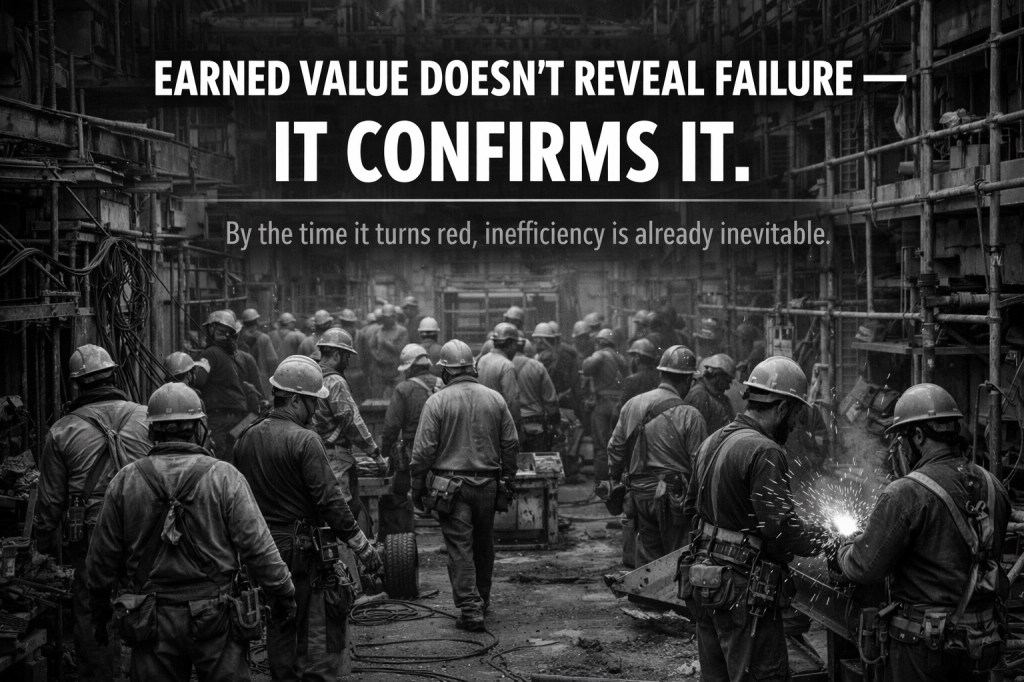
Earned Value Management (EVM) is often treated as the ultimate truth-teller.
Numbers don’t lie.
Metrics don’t have opinions.
Dashboards don’t have egos.
And yet — on project after project — EVM turns red after the outcome is already unavoidable.
That’s not a tooling problem.
That’s a systems problem.
What Earned Value Is Actually Good At
EVM is excellent at measuring one thing:
Variance against an assumed plan.
It tells you:
How much work was planned How much work was performed How much money was spent doing it
If the plan is sound, EVM is powerful.
If the plan is built on false assumptions about efficiency and capacity, EVM becomes a lagging indicator of inevitability.
The Assumptions EVM Inherits (But Never Questions)
Earned Value does not challenge the plan.
It inherits it.
Which means it also inherits every flawed assumption embedded upstream:
That unit measures priced reality That schedules were physically executable That productivity was stable That parallel work increased progress
When those assumptions break down on site, EVM doesn’t expose the root cause.
It simply reports the damage.
Why EVM Turns Red Too Late to Matter
Here’s the pattern almost everyone recognizes:
Early EV looks healthy SPI and CPI hover near 1.0 Confidence increases Crews are stacked to “maintain momentum”
Meanwhile, on site:
Congestion grows Waiting increases Productivity erodes Efficiency quietly collapses
But EV still looks acceptable — because work is technically being completed.
By the time EV clearly turns red:
Duration has already slipped Costs are already committed Recovery options are limited Narratives harden into blame
EVM didn’t warn you.
It confirmed what had already happened.
The Core Problem: EVM Measures Output, Not Capability
Earned Value answers:
“Did we complete the work we said we would?”
It does not answer:
“Was the system capable of sustaining this work efficiently?”
It cannot see:
Overcrowding Trade interference Idle labor masked as progress Declining utilization Capacity saturation
As long as output continues — even inefficiently — EV reports progress.
This is how projects stay “green” while being structurally doomed.
Why “Recovery” Makes Things Worse
When EV starts slipping, the standard response is predictable:
Add crews Increase parallel work Compress logic Authorize overtime
On dashboards, this looks like action.
On site, it often accelerates failure.
More crews in a constrained system don’t restore efficiency — they destroy it.
EV may temporarily stabilize…
while real productivity collapses even faster.
The Illusion of Control
This is the most dangerous part.
Earned Value creates a powerful illusion:
“If we can measure it, we can manage it.”
But you cannot manage what your metrics are blind to.
If EVM is not paired with:
Resource utilization visibility Capacity thresholds Congestion signals Efficiency decay indicators
Then it becomes a post-mortem tool disguised as a control system.
The CRU Position
CRU does not reject Earned Value.
CRU rejects the idea that EVM alone is sufficient.
EVM must sit downstream of:
Resource-based estimating Capacity-aware scheduling Utilization governance
Otherwise, it doesn’t prevent failure.
It documents it beautifully.
What Real Control Looks Like
Real control happens before variance appears.
It requires asking harder questions earlier:
How many people can this system actually absorb? Where does efficiency begin to decay? What does congestion cost per week? Which constraints are binding right now?
When those questions are answered, EV becomes useful again — because it is measuring a plan grounded in reality.
Final Thought
Earned Value doesn’t tell you why projects fail.
It tells you when failure becomes undeniable.
If your controls only speak after the system has already broken, they aren’t controls.
They’re witnesses.
 Resource Management