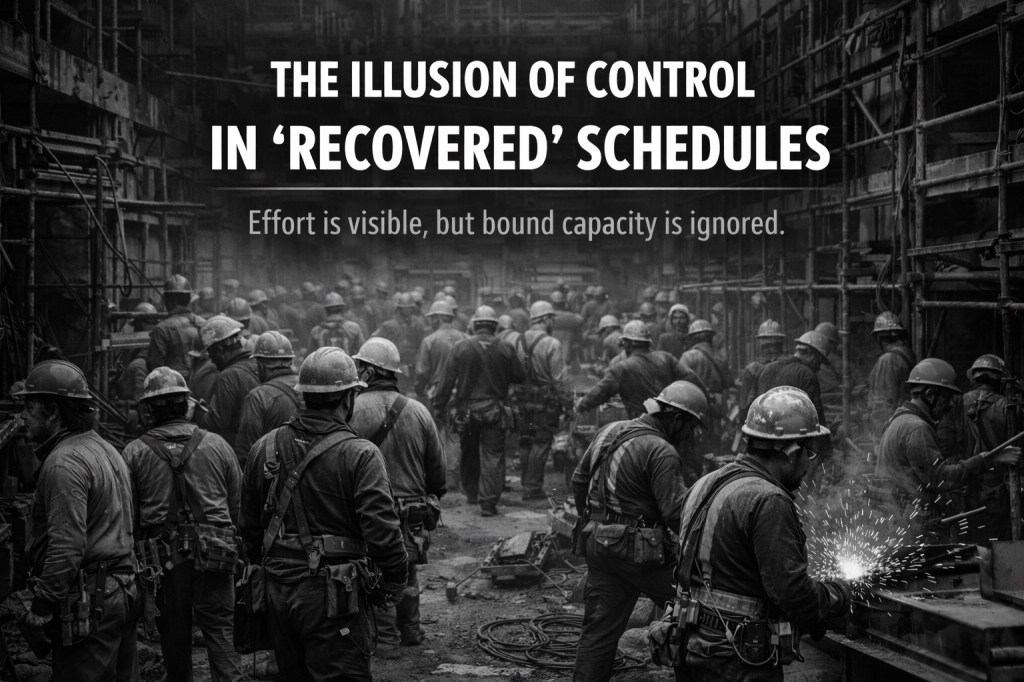
Recovered schedules are one of the most dangerous artifacts in project delivery.
They look decisive.
They sound responsible.
They reassure leadership.
And more often than not, they are fiction.
What a “Recovered” Schedule Really Is
A recovered schedule is not proof of regained control.
It is proof that the planning system still believes control comes from logic, not capacity.
When a schedule slips, the recovery playbook is familiar:
Add parallel work Increase crew sizes Compress logic Authorize overtime Resequence activities
On paper, the finish date moves back into alignment.
On site, efficiency collapses.
Why Recovery Plans Feel So Convincing
Recovered schedules are persuasive because they operate in a world without physical limits.
They assume:
Space can absorb more people Supervision can scale instantly Logistics can stretch indefinitely Productivity remains constant under pressure
The schedule doesn’t see congestion.
It doesn’t feel interference.
It doesn’t register waiting.
So it declares victory.
The Control Paradox
This is the paradox at the heart of recovered schedules:
The more pressure the system is under,
the more the plan assumes efficiency.
As performance degrades, recovery logic demands more parallelism.
As congestion grows, the schedule responds by adding density.
What looks like control is actually accelerated loss of control.
Why “More Crews” Rarely Means More Progress
When capacity is constrained, adding crews:
Increases trade stacking Raises coordination overhead Expands idle and standby time Degrades individual productivity Amplifies rework and safety risk
Recovered schedules treat labor as infinitely scalable.
Real sites do not.
The result is a widening gap between planned progress and actual throughput.
How Recovered Schedules Mask Failure
Recovered schedules don’t fail loudly.
They fail by:
Hiding efficiency loss inside activity progress Shifting blame to execution teams Normalizing overtime and heroics Creating false confidence in reporting cycles
By the time recovery is proven impossible, cost and time are already sunk.
The schedule didn’t prevent failure.
It postponed recognition of it.
The Illusion of Control
Recovered schedules give leaders something dangerous:
The feeling that something is being done.
But control is not activity.
Control is constraint awareness.
If the recovery plan does not explicitly answer:
What capacity is binding? Where productivity will degrade? How many people the system can truly absorb? What efficiency loss is being traded for time?
Then it isn’t control.
It’s choreography.
The CRU Position
CRU challenges the idea that schedule recovery is primarily a logic exercise.
True recovery is a capacity decision, not a sequencing one.
Sometimes the most controlled decision is:
Slowing down Reducing parallelism Rebalancing crews Accepting short-term delay to prevent long-term collapse
Recovered schedules rarely allow those conversations.
What Real Control Looks Like
Real control is visible before recovery is needed.
It means:
Governing crew density Protecting critical workfaces Limiting parallel execution Measuring utilization, not just progress Making trade-offs explicit, not hidden
When control is real, recovery plans are rare.
Because the system never pretended it could do the impossible.
Final Thought
Recovered schedules don’t demonstrate control.
They demonstrate belief.
Belief that logic can overpower physics.
Belief that people can absorb unlimited pressure.
Belief that efficiency will return if we push hard enough.
Reality always wins.
And when it does, the schedule isn’t in control.
It never was.
 Resource Management