Most construction estimates don’t fail because the estimator made a mistake.
They fail because the estimating method assumes a world that doesn’t exist.
Unit-measure estimating has been the industry default for decades. It is familiar, defensible, auditable, and easy to benchmark. It produces neat numbers that look precise and give decision-makers confidence.
And yet, time after time, projects blow past those numbers.
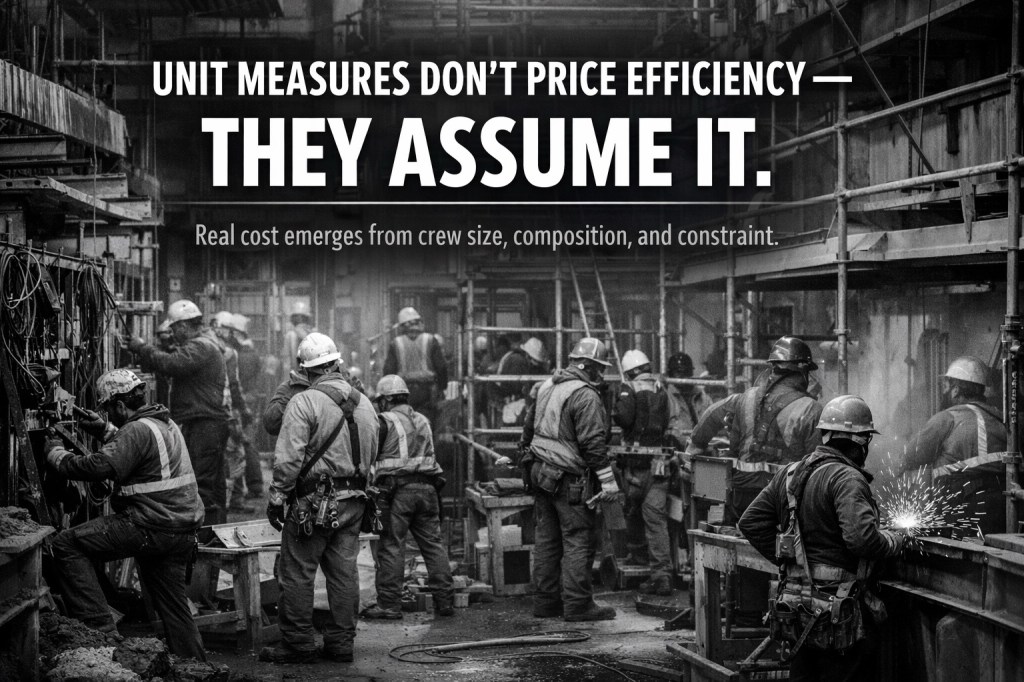
Not because quantities were wrong — but because efficiency was assumed, not priced.
The Core Flaw in Unit-Measure Estimating
At its core, unit-measure estimating prices work output:
Cost per metre Cost per unit Cost per installation
What it does not price is how that work is actually executed.
Unit measures implicitly assume:
Crews can work in clean sequence Trades can operate independently Productivity is stable and repeatable Resources appear exactly when needed No meaningful interference exists between activities
In other words, unit measures assume that work happens in series.
Real projects operate in parallel.
And that difference is where efficiency is lost — and cost is born.
Efficiency Is Not a Rate — It’s a System Outcome
Efficiency does not live inside a unit rate.
Efficiency emerges from:
Crew size and composition How many crews are present at the same time Shared access, space, supervision, and logistics Training, onboarding, rotation, and fatigue The physical limits of the site
None of these variables are priced by unit measures.
They are assumed away.
A unit rate might tell you what a task costs under ideal conditions.
It tells you nothing about what happens when ten crews are competing for the same access, the same space, the same supervisors, and the same support systems.
Why Crew Size and Makeup Change Everything
Two projects can have identical scope, quantities, and unit rates — and still diverge by millions.
Why?
Because cost is driven by who is on site, when, and in what combination.
Crew size and composition determine:
How much parallel work is attempted How much interference is created How much idle time accumulates How quickly productivity degrades under congestion
Unit-measure estimating has no mechanism to model this.
It assumes that adding crews adds progress.
In reality, adding crews often adds friction.
More people does not mean more output once capacity limits are reached.
It often means more waiting, more rework, more coordination overhead, and more inefficiency.
The Hidden Cost Unit Measures Never See
When efficiency collapses, unit-measure estimates don’t break loudly.
They bleed quietly.
Costs don’t appear as line-item errors — they surface as:
Extended durations Standby and idle time Overtime used to “recover” Layered supervision Productivity erosion masked as execution issues
By the time cost overruns are visible, the damage has already occurred.
The estimate didn’t predict failure — it assumed it away.
Estimating Based on Resources Changes the Game
A resource-driven estimate flips the logic.
Instead of asking:
“How much should this quantity cost?”
It asks:
“What does it cost to sustain this system of work over time?”
When estimating is anchored in resources:
Crew size becomes a primary cost driver Parallel work is treated as a risk, not a benefit Efficiency is measured, not assumed Constraints are surfaced early Cost becomes a consequence of behavior, not a guess
This is not about being pessimistic.
It is about being honest.
Why This Matters More on Megaprojects
The larger and more complex the project, the more dangerous unit-measure assumptions become.
Megaprojects amplify:
Trade stacking Shared constraints Logistics bottlenecks Workforce saturation Coordination overhead
Unit measures scale quantities easily.
They do not scale complexity.
That gap is where megaprojects lose control.
The CRU Perspective
CRU exists because the industry has spent too long managing outputs instead of systems.
If efficiency is critical to cost — and it is — then efficiency must be:
Modeled Measured Governed Actively managed
You cannot manage what your estimate refuses to see.
Unit-measure estimating isn’t obsolete.
But it is insufficient.
And until the industry accepts that efficiency is an outcome of resource behavior — not a property of a unit rate — cost overruns will continue to surprise teams who did everything “by the book.”
Final Thought
If your estimate assumes perfect sequencing, stable productivity, and unlimited capacity…
It isn’t predicting cost.
It’s assuming efficiency — and hoping reality cooperates.
Reality never does.
 Resource Management