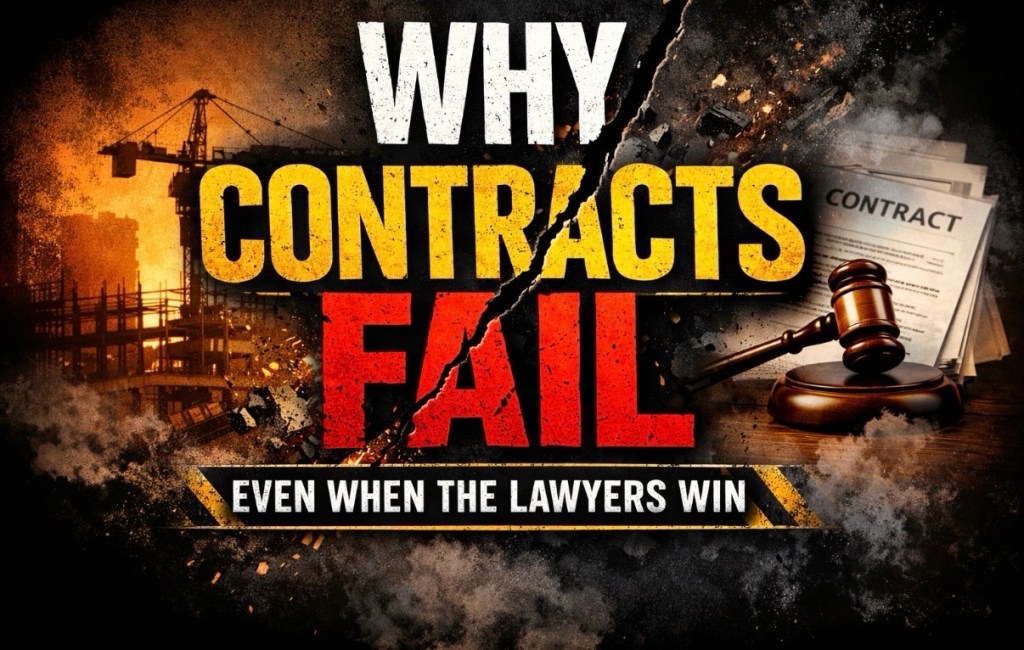
Most megaproject disputes don’t start with bad contracts.
They start with good contracts operating inside broken delivery systems.
I’ve seen billion-dollar projects where:
The contract was technically sound Risk allocation was clearly written Change mechanisms were compliant Legal positions were defensible
…and yet the project still devolved into claims, friction, and commercial trench warfare.
Not because anyone breached the contract —
but because the contract was never designed to manage how work actually flows.
⚠️ The Hidden Assumption Inside Most Contracts
Most contracts quietly assume:
Stable access to work areas Predictable productivity Clean interfaces between contractors Unlimited buffering capacity Rational decision cycles Linear sequencing Infinite space, logistics, and shared services
That world does not exist on real megaprojects.
Reality looks more like:
Parking caps limit workforce ramp-up Lunchrooms, gates, laydown and cranes become bottlenecks Trades stack on top of each other chasing the same access Interfaces collide daily Productivity erodes silently before anyone can prove causality Decisions lag while the field improvises Schedules remain logically correct and physically impossible
Contracts don’t fail here.
The system fails — and the contract becomes the weapon of last resort.
🧨 Where Disputes Actually Come From
Disputes rarely originate from a single event.
They accumulate through invisible operational drift:
Congestion increases → productivity decays Resequencing becomes constant → logic credibility erodes Temporary fixes become permanent behaviors Access restrictions normalize Resource stacking becomes the default Change backlog grows Commercial trust degrades Everyone starts protecting their position instead of optimizing flow
By the time cost variance shows up, the damage is already baked in.
Claims don’t create conflict.
They simply reveal it.
🧠 Contract Administration Is Not Paperwork — It’s System Control
Strong contract administration is not:
Managing correspondence Policing clause compliance Arguing entitlement Chasing signatures Building defensive records
That’s late-stage behavior.
High-performing projects use contract administration to:
Detect operational drift early Surface constraint buildup Stabilize production flow Resolve friction before positions harden Align behavior with commercial intent Maintain trust while protecting accountability
The goal isn’t winning disputes.
The goal is preventing the system conditions that create them.
🔎 The Blind Spot: We Manage Outputs, Not Capacity
Most project controls still focus on:
Schedule logic Milestones Earned value Percent complete Cost variance
These measure outcomes — not constraints.
They tell you what already happened.
They don’t tell you what’s about to break.
Very few projects actively manage:
Physical capacity limits Space utilization Access throughput Shared service loading Shift congestion Interface density Resource stacking risk
Yet these are the real drivers of productivity, predictability, and claims.
When capacity is unmanaged, commercial stability becomes impossible — no matter how strong the contract is.
🎯 The Real Question Leaders Should Be Asking
Not:
“Is the contract enforceable?”
But:
“Is our delivery system capable of executing what the contract assumes?”
If the system cannot absorb variability, complexity, and constraint — disputes are inevitable.
You can’t lawyer your way out of physics.
🚀 The Opportunity
Megaproject performance will not improve by writing smarter clauses.
It will improve when organizations:
Treat capacity as a managed asset Design governance around flow, not just compliance Instrument constraints instead of hiding them Align incentives with system stability Surface risk before it becomes commercialized Run projects as integrated operating systems — not fragmented contracts
That’s where disputes disappear — not because anyone surrendered leverage, but because the system stopped creating friction in the first place.
 Resource Management