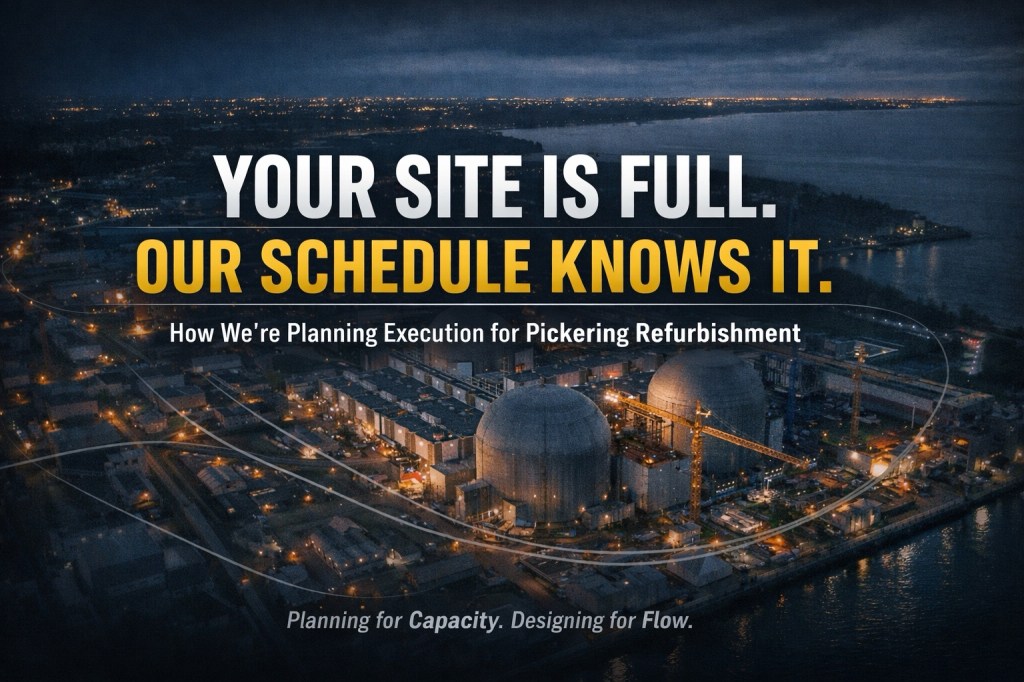
How We’re Planning Execution for Pickering Refurbishment
Dense urban mega-projects don’t fail because teams can’t plan.
They struggle when planning ignores physical reality.
Pickering Refurbishment is different by design.
We are planning for a site that is capacity-constrained, space-limited, and flow-dependent — because that is the real operating environment. Our execution model starts with absorption capacity, not with optimistic production curves.
This is what “execution readiness” looks like when you take physical constraints seriously.
We Start With Capacity, Not Milestones
Before locking schedules, we are engineering the constraints that actually govern production:
Maximum daily site headcount by phase Gate and security throughput by time window Parking capacity and shuttle throughput Active workface availability by building / zone Laydown and material staging limits Peak delivery volumes without re-handling Welfare and cafeteria capacity at peak load
The schedule is being built inside these limits, not on top of them.
That ensures what we approve is physically executable on Day 1.
We Are Designing for Flow, Not Just Compliance
Execution at Pickering is being structured as a flow system:
Traffic & Shift Phasing
Shift start times and crew waves are aligned to real traffic patterns and site absorption rates.
Security Throughput as Production Infrastructure
Gate capacity is being treated as a production input. Peak flows are modeled, not assumed.
Parking, Shuttles & Remote Staging
Manpower is governed by parking and shuttle throughput. Remote staging and shuttle loops are capacity creators, not conveniences.
Space as a Governed Resource
Workfaces, laydown zones, and temporary works are being zoned, time-boxed, and sequenced to protect trade flow and prevent interference.
Material Flow by Design
Delivery windows and staging are aligned to space availability. Just-in-time delivery is being used to reduce congestion and double handling.
Welfare Facilities as a Productivity Enabler
Cafeteria and break capacity are being sized to peak loads to sustain morale, safety, and afternoon productivity.
What This Changes on the Ground
This approach removes daily friction from execution:
Crews arrive on time and get to work Workfaces are available when scheduled Materials land where they are needed Trade interference is designed out, not managed reactively Safety improves as congestion drops Productivity becomes predictable
Execution becomes controlled instead of heroic.
The Standard We’re Setting
Pickering Refurbishment is not being run as a traditional schedule-driven job.
It is being run as a capacity-governed production system.
This means:
We cap work to what the site can absorb We invest in throughput infrastructure We sequence around space, not just logic We protect flow so trades can produce
That’s not conservative.
That’s how complex work gets delivered in constrained environments.
Final Word
The site is finite.
The city is real.
The constraints are known.
By planning for a full site from the start, Pickering Refurbishment is grounding execution in physical reality — so the schedule doesn’t fight the site, and the people doing the work aren’t set up to fail.
Your site is full.
Our schedule knows it.
 Resource Management