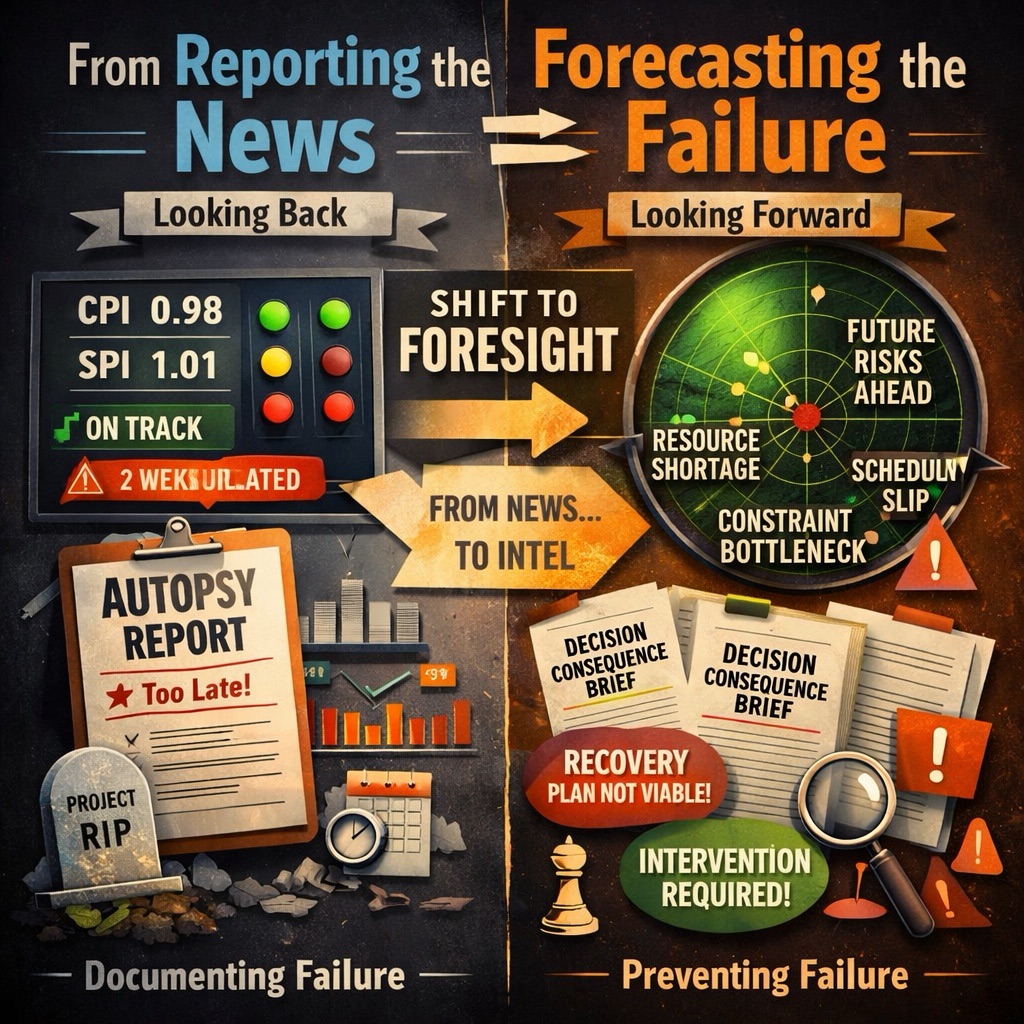
Most project reporting is journalism.
The job of leadership is intelligence.
And confusing the two is why billion-dollar programs “discover” problems only after the value is already lost.
Every month, PMOs publish pristine dashboards:
CPI: 0.98 SPI: 1.01 RAG: Mostly Green Milestones: “At Risk” (again)
Executives are told the news.
They are not given foresight.
That distinction is the difference between governing outcomes and post-morteming them.
The What: Reporting vs. Forecasting (They Are Not the Same Discipline)
Reporting the news answers:
What happened?
It is backward-looking.
It narrates variance after damage has already occurred.
Forecasting the news answers:
What will happen if we keep making these decisions?
It is forward-looking.
It exposes future consequences while there is still optionality.
This is not semantics.
It is the difference between:
Reporting (Journalism)
Forecasting (Intelligence)
Variance after the fact
Constraint exposure before impact
CPI/SPI snapshots
Feasibility of future performance
Milestones “at risk”
Structural impossibility of recovery
“We’re 2 weeks late”
“Your recovery plan requires resources you don’t have”
Historical trend lines
Decision consequence modeling
Most PMOs are historical narrators.
Leadership needs predictive governors.
The Why: Reporting the News Is Organizational Self-Deception
The industry mistake is believing that accuracy of reporting = effectiveness of governance.
It doesn’t.
You can report perfectly and still fail predictably.
Reporting fails leadership because:
1️⃣ It hides structural impossibility
Your recovery plan assumes:
Crew availability that doesn’t exist Procurement lead times that won’t compress Access windows that are already saturated Workfaces that physically cannot support parallel crews
Reporting never tests feasibility.
It simply reports intent as if intent were capability.
2️⃣ It rewards optics over intervention
Green dashboards signal “competence.”
Amber dashboards signal “management.”
Red dashboards signal “career risk.”
So the system self-optimizes for appearance, not truth.
3️⃣ It is epistemically too late
By the time CPI/SPIs move materially:
Commitments are locked Contracts are signed Claims positions are forming Political capital is spent
At that point, reporting becomes documentation of failure, not prevention of it.
Executives don’t need better dashboards.
They need earlier truth.
The How: How to Turn Project Reporting into Predictive Intelligence
This is not a tooling problem.
This is a governance design problem.
To forecast the news, your PMO must structurally change what it measures, how it models reality, and who it is accountable to.
🔹 Step 1 — Replace Variance Metrics with Feasibility Metrics
Stop asking:
Are we on budget and schedule?
Start asking:
Is the future plan physically executable?
Introduce metrics that test structural plausibility:
Resource Feasibility Index Can the planned work be executed with the actual labor available?
Constraint Saturation Ratio Are access, permits, inspections, space, tooling, or materials already bottlenecked?
Decision Optionality Index How many viable recovery paths remain? Progress Confirmation Latency How long does it take for reality to show up in reports?
Crew Continuity Risk Are we structurally fragmenting crews across workfaces, destroying productivity while CPI stays “fine”?
These metrics forecast failure before variance appears.
🔹 Step 2 — Model Consequences, Not Activities
Most schedules model what people hope to do.
Forecasting models what will happen if they try.
Your planning discipline must answer:
If we pull 14 electricians from Workface A to recover Workface B, what downstream slippage becomes mathematically inevitable?
If procurement slips 3 weeks, which milestones become structurally unrecoverable?
If headcount caps remain fixed, which parts of the critical path become fantasy?
This requires:
Trade-level capacity modeling Access and workface saturation logic Logistics throughput modeling Crew continuity economics Schedule logic that reflects execution friction, not just dependencies
If your schedule can be “recovered” without any physical or organizational pain showing up, it is lying.
🔹 Step 3 — Separate Oversight from Delivery
Delivery teams are structurally biased.
Not morally — structurally.
They are measured on:
Hitting commitments Maintaining confidence Avoiding escalations
That makes them incapable of producing uncomfortable forecasts.
Forecasting must sit outside delivery:
Alongside Finance Alongside Audit Alongside Risk
This function exists to answer one question:
Is the organization driving toward an outcome that is structurally achievable?
Not:
Did the team work hard this month?
Effort is not governance.
Foresight is.
🔹 Step 4 — Replace RAG Status with “Decision Consequence Briefs”
Instead of status reports, executives need:
Decision Consequence Briefs
Each brief answers:
What decision was made? What constraint does it activate? What future options does it eliminate? What failure becomes probable because of it? What intervention still exists — and when it expires?
This converts leadership meetings from:
“Why are we late?”
to
“Which failure mode are we choosing to accept?”
That is governance.
🔹 Step 5 — Make Forecasting Politically Protected
Truth that arrives early is uncomfortable.
Truth that arrives late is career-safe.
Forecasting only works if the organization protects early truth.
That requires:
Formal separation of forecasting from delivery performance evaluations Executive sponsorship of “bad news early” Rewarding prevented failures, not heroic recoveries Penalizing surprises, not candor
If your PMO punishes accurate foresight, you have designed failure.
The Game Changer: From Newsroom to Intelligence Function
When done properly, project management stops being a reporting function and becomes a governance intelligence function.
You stop saying:
“We are two weeks behind.”
You start saying:
“Your recovery plan requires labor you do not have, access you cannot secure, and decisions you’ve already delayed past the point of optionality. If unchanged, failure will occur by X date. Here are the last three viable interventions.”
That is not project management.
That is organizational foresight.
That is what prevents failure instead of explaining it.
The Hard Truth
Most PMOs don’t fail because they are incompetent.
They fail because they are structurally designed to report the past instead of interrogate the future.
Until forecasting consequences becomes the primary function of planning,
your dashboards will remain beautifully formatted autopsies.
And leadership will keep learning the news
after the outcome is already decided.
 Resource Management