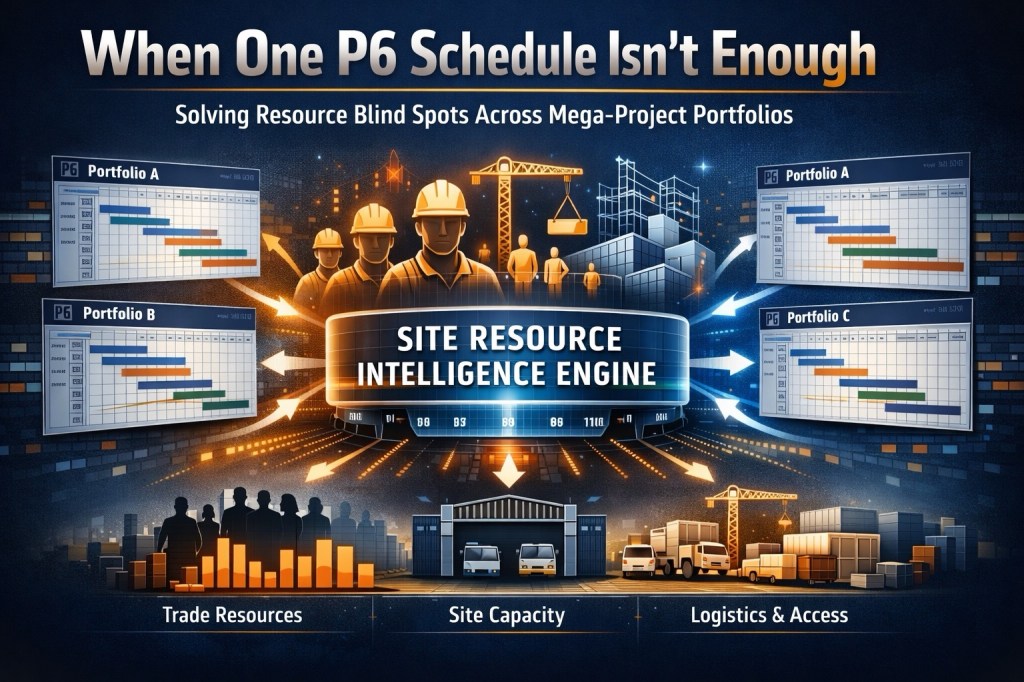
Large industrial programs eventually reach a point where the scheduling architecture starts fighting the project.
Not because the planners are weak.
Not because the tools are wrong.
Because the scale of the work exceeds how the scheduling environment was designed to operate.
This happens frequently on mega-projects where multiple Primavera P6 environments are running in parallel to support separate portfolios, bundles, or contractors. Each instance works independently, but the site itself is a single physical system.
Parking is shared.
Access gates are shared.
Trades are shared.
Laydown areas are shared.
Lunchrooms are shared.
Cranes, scaffolding, logistics crews — shared.
Yet the schedules are not.
And that is where the blind spot begins.
The Structural Problem
Many owners historically manage projects through logic networks and milestone governance.
Milestones confirm whether work packages start and finish when expected.
Logic ensures that sequencing dependencies are respected.
But logic alone does not deliver projects. Resources do.
When multiple portfolios exist across separate P6 environments, the following structural issues emerge:
1. Resource Visibility Disappears
Each schedule may appear achievable when viewed independently.
But the combined resource demand across all schedules is invisible.
Ten schedules may each show:
40 electricians required 30 pipefitters required 20 ironworkers required
Individually acceptable.
Combined reality:
400 electricians required on a site that only has capacity for 180.
The schedules look feasible.
The project is not.
2. Critical Paths Become Misleading
Traditional CPM assumes logic drives criticality.
On large construction sites, resource availability determines the real critical path.
The constraint may not be an activity predecessor.
It may be:
Gate access throughput Trade labor supply Crane availability Laydown capacity Security clearance processing Scaffold crews
These are site constraints, not logic dependencies.
Without modeling them, the schedule describes intent, not achievable execution.
3. Fragmented P6 Instances Prevent Portfolio Optimization
Multiple P6 databases often exist because:
Portfolio sizes exceed database performance limits Contractors manage separate schedule environments Security or contractual separation is required Schedule size exceeds comfortable operational scale
While this fragmentation solves technical performance issues, it creates a portfolio intelligence gap.
No single system answers the question:
What is the total resource demand across the site next week?
Or more importantly:
Can the site physically execute the work being scheduled?
The Blind Spot: Milestones Without Capacity
When owners rely primarily on milestone tracking, the program becomes reactive.
Milestones show when failure has already occurred.
They do not show when capacity will be exceeded before the work begins.
Without integrated resource visibility:
Trade stacking occurs Site congestion increases Productivity collapses Rework increases Safety risk rises Contractors compete for the same labor pool
The schedule still looks logical.
But execution becomes chaotic.
The Solution: A Site-Level Resource Integration Layer
The answer is not to force every portfolio into a single massive P6 schedule.
At mega-project scale, that approach becomes unmanageable and slow.
Instead, the solution is to introduce a Portfolio Resource Integration Layer above the individual schedules.
This layer acts as the site’s execution intelligence system.
Each portfolio schedule continues operating independently.
But resource demand is extracted and integrated centrally.
Step 1: Standardize Resource Dictionaries
Across all schedules:
Trades must be standardized.
Example resource taxonomy:
ELEC_JRN ELEC_APP PIPE_JRN IRON_JRN CARP_FORM LAB_GEN
Without a common dictionary, aggregation becomes impossible.
This is the first governance step.
Step 2: Extract Weekly Resource Demand
From each P6 portfolio:
Export time-phased resource demand:
Trade Work area Time period (weekly or daily) Headcount required
This creates a site-wide demand model.
Now the program can answer:
Total electricians required next week Total scaffold crews required next month Total crane demand per zone
Step 3: Define Site Capacity Constraints
The site itself has physical limits.
Examples:
Parking capacity
Security gate throughput
Lunchroom capacity
Maximum trade headcount
Laydown limits
Workface density limits
These constraints define the maximum achievable workforce per time period.
Step 4: Perform Resource Feasibility Analysis
Now demand can be compared to capacity.
This reveals:
Trade shortages Area congestion Resource conflicts Logistics bottlenecks
Instead of discovering these during construction, they become visible months in advance.
Step 5: Adjust Schedules Before Execution
Once conflicts are identified:
Schedules can be adjusted by:
Shifting work sequences Rebalancing trade demand Staggering area releases Adjusting crew sizes Coordinating contractors
This is portfolio-level resource optimization.
The Result: From Schedule Control to Execution Control
Most projects manage schedule compliance.
Few manage execution capacity.
When resource integration is introduced:
The program can answer the most important delivery question:
Not “Is the schedule logical?”
But “Can the site physically execute the plan?”
This is the difference between planning work and delivering work.
A New Role for Owners
Owners cannot remain milestone observers on mega-projects.
When multiple portfolios share the same site, the owner becomes the governor of execution capacity.
That responsibility includes:
Trade demand visibility Site throughput management Shared services coordination Portfolio resource balancing
Without this layer, the project may have perfect schedules and still fail.
Final Thought
On mega-projects, the constraint is rarely the schedule logic.
The constraint is almost always site capacity and trade resources.
When multiple P6 environments exist without a portfolio resource integration layer, the program is effectively flying blind.
Not because the schedules are wrong.
Because the system that connects them does not exist.
And without that system, the project is not being managed.
It is being discovered in real time.
 Resource Management