CONSTRUCTION RESOURCE UTILIZATION ·
How carrying cost hides inside your baseline, inflates your metrics, and kills your budget predictability — while everyone reports green.
Here’s a question nobody on your project is asking: how much of your labor spend is paying people to stand around?
Not overtime. Not rework. Not change orders. Just time — paid, scheduled, contractually embedded time where a crew is on your site, on your payroll, and doing absolutely nothing productive. The industry has a term for it: carrying cost. Standby hours. Idle time. Whatever you want to call it, it shows up in every vendor bid, every staffing curve, every baseline schedule. And nobody is tracking it.
That’s not an oversight. It’s a structural blind spot. And it’s one of the biggest silent drivers of cost growth on capital projects today.
THE MECHANISM
Vendor bids include assumptions about downtime. They have to — mobilization gaps, sequencing delays, jurisdictional ratio requirements, ramp-up periods, weather windows. These are real constraints. The problem isn’t that the downtime exists. The problem is where it goes once the bid becomes a baseline.
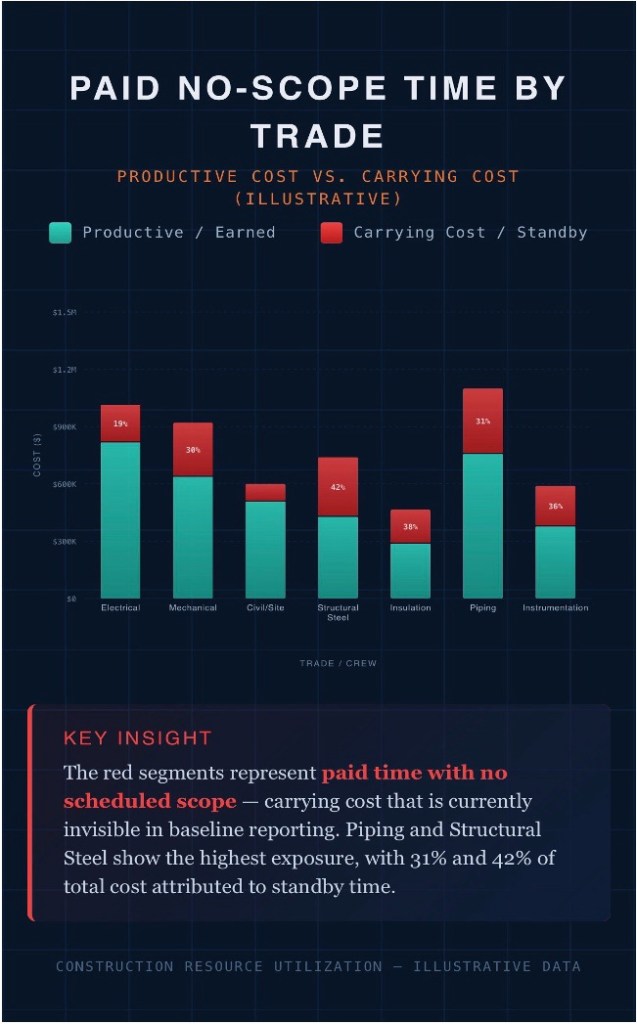
Right now, those standby hours get folded into the cost baseline as if they were productive work. Your project controls system has no clean way to code “paid time with no scheduled scope.” So carrying cost becomes invisible — blended into earned value, smoothed across staffing curves, buried in vendor-level rollups that look fine at 30,000 feet.
You can’t manage what you’ve blended into the noise floor. And right now, carrying cost is the noise floor.
The downstream effects cascade fast. Your whitespace metrics get inflated because standby hours pad the supply numbers. Your schedule looks feasible on paper because the plan doesn’t distinguish between productive and non-productive time. And when cost growth finally shows up — it shows up as an unexplained estimate delta, not as a controllable driver with an owner and a cause code.
By then, it’s too late. The money’s spent. The executive conversation is about “what happened” instead of “what can we still do about it.
WHY NOBODY CATCHES IT
Three reasons, and they compound.
First, project controls doesn’t have a code for “nothing.” The work breakdown structure tracks scope. The cost system tracks labor categories. Neither is built to capture “we’re paying this crew but they have no activities this week.” So the hours get slotted into the nearest bucket and blended away.
Second, vendor-level rollups hide the damage.A vendor might show 94% planned utilization across their contract. That number is meaningless if one crew is at 58% and another is at 100% but running the wrong sequence. The bottlenecks are trade-specific and crew-specific. Vendor averages are a comfort blanket.
Third, nobody wants to find it. Carrying cost is uncomfortable. It implies the schedule has slack that someone approved, that a bid was accepted with embedded fat, that a baseline was built on assumptions nobody validated. Surfacing it creates accountability. And accountability, as we all know, is the thing capital projects are worst at distributing.
WHAT IT ACTUALLY COSTS YOU
Let’s make it concrete. If you have 200 standby hours per week across a handful of trades at a blended rate of $85/hour, that’s $17,000 a weekin carrying cost. Over a 6-month construction phase, that’s roughly $440,000 — burned with no earned value to show for it. On a large program with multiple vendors, multiply that by three or four.
Now add the second-order costs: schedule extensions caused by cascading trade delays, re-mobilization costs, overtime premiums to compress what should have been done during the downtime. The carrying cost isn’t just the idle hours. It’s the decisions you didn’t make because you couldn’t see the idle hours.
The most expensive hour on your project isn’t overtime. It’s the standby hour that nobody coded, nobody tracked, and nobody owned.
WHAT TO DO ABOUT IT
Split the hours. Every trade, every period: productive hours vs. carrying cost hours. Give standby its own line. Give it cause codes — mobilization gap, sequencing constraint, predecessor delay, jurisdictional ratio, weather. Make it visible and make it countable.
Validate bids before they become baselines.When a vendor submits a staffing curve, stress-test the assumptions. What’s the ramp rate? What are the jurisdictional ratios? Where are the planned gaps? If the bid has 15% embedded downtime and nobody questioned it, that’s not a vendor problem — that’s a governance failure.
Manage whitespace at the trade level, not the vendor level. Stand up a weekly trade-by-trade review: productive vs. standby hours, top downtime causes, constraint owners, mitigation commitments. If you’re only looking at vendor rollups, you’re looking at the wrong altitude.
Force a decision when downtime exists. When you can see carrying cost clearly, you have exactly four moves: densify the schedule, redeploy the crew, repackage the work, or pull a commercial lever. What you don’t get to do anymore is absorb it silently and explain it later as a “variance.”
THE BOTTOM LINE
Construction’s cost problem isn’t just about scope growth, change orders, or productivity rates. A massive and under-examined driver is time itself — specifically, paid time with no productive output, embedded into baselines, invisible to controls, and unmanaged by anyone.
The fix isn’t a new tool. It isn’t a software upgrade. It’s a decision: make carrying cost visible, measurable, and owned. The data is already in your bids and schedules. You just have to stop blending it into the noise and start treating it like what it is — a controllable cost driver that someone needs to manage every single week.
Or keep reporting green while the budget bleeds. Your call.
CONSTRUCTIONRESOURCEUTILIZATION.COM
Making the invisible cost of time impossible to ignore.
 Resource Management