The industry says it needs half a million new workers. The data says it’s wasting 40% of the ones it already has. One of these problems is solvable without a single new hire.
Kyle MussmacherApril 2026 9 min read
Every year, the same headline hits every trade publication: the construction industry needs hundreds of thousands of new workers or the sky will fall. In 2026, the number is approximately 500,000. Last year, it was 439,000. The year before, north of 500,000 again. The number moves. The narrative doesn’t.
And every year, the industry’s collective response is the same: recruit harder. Market better. Tell high schoolers that construction is a “career of choice.” Build more apprenticeship pipelines. Raise wages.
None of this is wrong. All of it is incomplete. Because the construction labor crisis isn’t primarily a supply problem. It’s a utilization problem. And until the industry is willing to say that out loud, it will keep hemorrhaging productivity while begging for bodies.
You don’t have a headcount shortage. You have a wrench-time problem dressed in workforce development clothing.
THE NUMBER NOBODY WANTS TO TALK ABOUT
Roughly 40% of a construction worker’s time on site is non-productive. Not marginally unproductive. Not “could be optimized.” Forty percent — spent waiting, idle, reworking, walking to the wrong location, or standing around because materials aren’t staged, tools aren’t available, or the preceding trade hasn’t cleared the work face.
That means on a project with 1,000 craft workers, 400 full-time equivalents worth of labor capacity is being vaporized every single day. Not by lazy workers. Not by bad attitudes. By bad systems. By fragmented work packaging. By project teams that treat resource synchronization as someone else’s job.
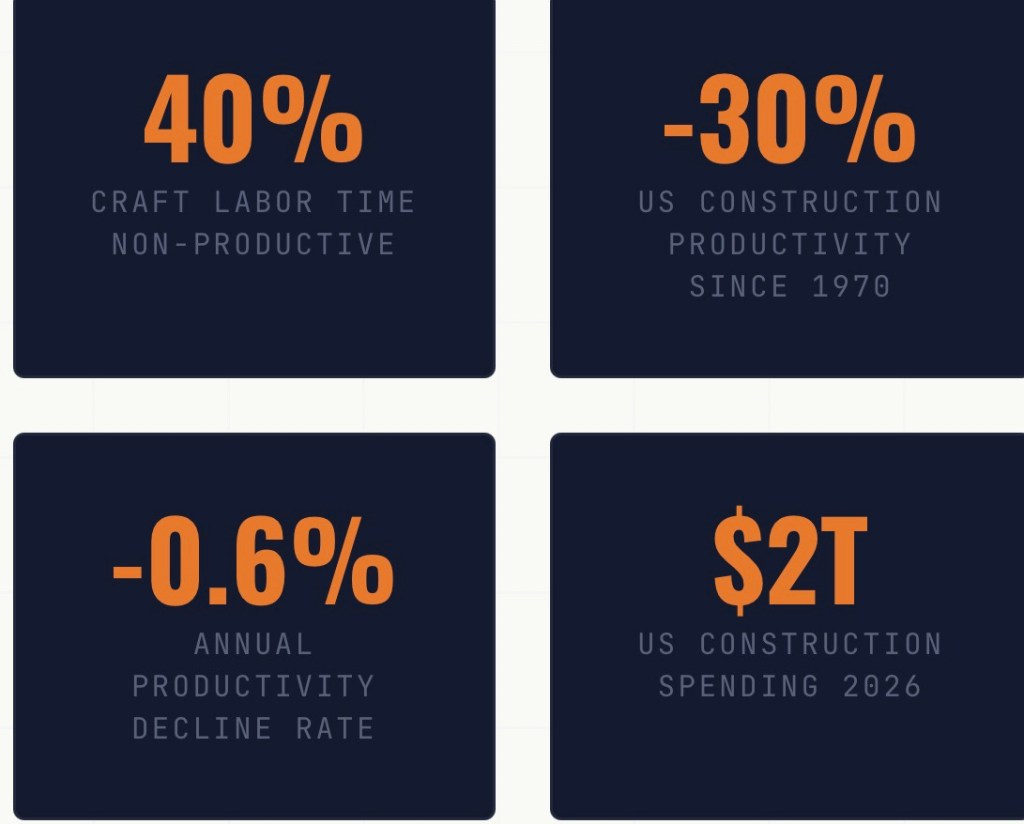
Let that sink in. A two-trillion-dollar industry is operating at roughly 60% labor effectiveness — and its primary strategic response is to hire more people into the same broken system.
WHY THE LABOR NARRATIVE SURVIVES
The labor shortage narrative persists because it’s convenient. It externalizes the problem. If we can’t find enough workers, then cost overruns and schedule slippage aren’t management failures — they’re market conditions. Nobody gets fired for a labor shortage. Plenty of people should get fired for a utilization rate that would be career-ending in any other industry.
Manufacturing solved this decades ago. Aerospace solved it. Automotive solved it. They built integrated planning systems, synchronized resource flows, and treated idle time as a defect — not an inevitability. Construction, despite being a $13 trillion global industry, still largely plans work in siloed spreadsheets, sequences trades by tribal knowledge, and accepts that a third to half of every labor dollar buys nothing.
Goldman Sachs Research (Feb 2026): US construction labor productivity has fallen at an average pace of 0.6% per year since 1965. Economy-wide productivity grew at 1.6% per year over the same period. Among all major G10 countries, the US has experienced the largest decline.
This isn’t a measurement artifact. Researchers at the University of Chicago confirmed the productivity decline is real and not the result of statistical error. The estimated hours per square foot to build a single-family home are nearly identical in 1993 and 2026. Thirty-three years. No improvement. Every other industry on earth would consider that an emergency. Construction considers it Tuesday.
THE REAL BOTTLENECK: WORK PACKAGING AND RESOURCE SYNCHRONIZATION
When a worker is standing idle on a construction site, the instinct is to blame the worker or blame the shortage. The correct response is to ask: why is the work face not ready?
In most cases, it’s one of four failures, none of which are solved by hiring:
Materials aren’t staged. Someone ordered them. Nobody coordinated delivery with the installation window. The steel is on site. It’s just in the lay down area 400 meters from where it’s needed, and the crane that was supposed to move it is rigged on a different lift.
The preceding trade hasn’t cleared.Electrical can’t pull wire because mechanical hasn’t hung duct. Mechanical can’t hang duct because structural hasn’t finished overhead steel. Nobody sequenced these work packages as an integrated system. They were planned in parallel by three different subcontractors who never looked at each other’s schedules.
Information is missing. The IFC drawings haven’t been issued for that area. Or they were issued, but with a hold on two penetrations that nobody flagged until the crew was already mobilized and standing in front of a concrete wall with no markings.
The work package itself is garbage. It’s too big, too vague, or sequenced against the physical logic of how the work actually gets built. It was written by a planner who hasn’t been on a scaffold in ten years, and it treats “install piping” as a monolithic activity rather than a synchronized chain of supports, spools, fit-up, welding, NDE, and hydro-test — each with different crew compositions, different material dependencies, and different quality hold points.
Every one of these is a resource utilization failure. Every one is solvable. And none of them require a single additional hire.
THE MEGA-PROJECT MULTIPLIER
If utilization waste is painful on a $50M commercial build, it’s catastrophic on a mega-project. Data centers. LNG facilities. Nuclear refurbishment. Semiconductor fabs. These are the projects driving the 2026 construction spending boom — and they are uniquely vulnerable to resource utilization failure because of their scale, complexity, and overlapping trade density.
On a mega-project, a 5% improvement in labor utilization doesn’t save a little money. It changes the project’s financial trajectory. It compresses schedule. It reduces carrying costs — the silent killer I’ve written about before — because every day you shave off a project with $2M/day in carrying costs is $2M you don’t burn.
And yet. Most mega-projects still resource-load their schedules with labor histograms built from averages, then act surprised when peak workforce requirements are 30% higher than planned. The workforce isn’t insufficient. The planning was.
You don’t need 30% more workers at peak. You need to stop building your resource plan from averages and start building it from constraint logic.
WHAT ACTUALLY MOVES THE NEEDLE
1. STRUCTURED WORK PACKAGES WITH CONSTRAINT CHECKS
Every work package should be constraint-checked before release: materials confirmed delivered and staged, preceding work confirmed complete, permits and quality docs in hand, tools and equipment available. If a single constraint isn’t met, the package doesn’t release. Full stop. This is not radical. This is basic manufacturing discipline applied to construction. The fact that it’s still uncommon tells you everything about the industry’s relationship with waste.
2. INTEGRATED RESOURCE PLANNING ACROSS TRADES
Stop letting every subcontractor plan in isolation and then “coordinate” at a weekly meeting where nobody changes anything. Resource planning must be integrated at the work face level — meaning trades are sequenced against each other spatially and temporally, with explicit handoff criteria and buffer management. This is systems thinking. Construction pretends it can’t do systems thinking because every project is “unique.” Every surgical patient is also unique. Surgeons still use checklists.
3. UTILIZATION AS A PRIMARY KPI
Most projects track schedule performance and cost performance. Almost none track labor utilization as a primary metric. If you’re not measuring wrench time, you’re not managing it. And if you’re not managing it, you are paying for it — every single day, on every single crew, on every single trade.
4. SHARED-SERVICE CONTRACTING ON MULTI-TRADE PROJECTS
On large projects with dense trade overlap, shared-service models — where common resources like scaffolding, rigging, and material handling are managed centrally rather than duplicated across subcontractors — eliminate one of the largest sources of idle time and resource conflict. This requires a different contracting philosophy and a different project governance model. It also saves millions.
THE EMPLOYMENT SIGNAL
Here’s the part nobody in workforce development wants to hear: the most valuable construction professionals in 2026 are not the ones who can recruit more bodies. They’re the ones who can extract more value from the bodies already on site.
Project managers who understand constraint-based planning. Resource coordinators who can synchronize ten trades across a multi-level work face. Construction planners who build schedules from installation logic rather than from calendar math. Consultants who can walk a site, diagnose a utilization problem in 30 minutes, and articulate the fix in language that both the field superintendent and the VP of capital projects can act on.
That’s where the industry’s real talent gap lives. Not in the trades. In the management layer that’s supposed to create the conditions for tradespeople to do productive work — and is failing at it, systemically, at scale.
The firms that figure this out will outperform. The ones that keep blaming the labor market will keep writing the same post-mortem on every project: “Workforce availability impacted the schedule.” No. Your utilization strategy impacted the schedule. The workforce was there. You just couldn’t keep them productive.
STOP HIRING INTO WASTE. START FIXING THE SYSTEM.
I help construction organizations diagnose utilization failures and build the planning systems, work packaging discipline, and contracting strategies that turn idle time into productive capacity — without adding headcount.
If your mega-project is bleeding labor dollars and your instinct is to mobilize more crews, we should talk first.
kyle@constructionresourceutilization.com →
 Resource Management