Every project has a schedule. Every project has a budget. Almost none of them have a whitespace strategy. That’s not an oversight — it’s the single most expensive norm in the construction industry.
!” Kyle Mussmacher !” April 2026 !” 9 min read
Here’s a question that should keep every project director awake at night: what happens to a $140/hour ironworker when there’s no iron to set?
He doesn’t vanish. He doesn’t pause his billing. He stands in a laydown yard, or he gets moved to a task that doesn’t need him, or most perversely he gets sent home and remobilized three days later at twice the coordination cost. His wages still accrue. The crane he was supposed to feed still sits on the pad burning rental. The concrete crew downstream that needed his embeds still waits.
That dead time between productive tasks is whitespace. And the construction industry, globally, has made a collective decision not a conscious one, but a decision nonetheless to pretend it doesn’t exist.
WHAT WHITESPACE ACTUALLY IS
Whitespace is the unproductive interval between planned work scopes where labor, equipment, and site infrastructure are mobilized but not generating value. It’s not the lunch break. It’s not the weather day. It’s the structural gap in how work is sequenced, contracted, and deployed that guarantees a portion of every crew-hour purchased produces nothing.
In a well-run manufacturing plant, this concept has a name: idle time. It’s measured, reported, and minimized with religious intensity. Toyota built an empire on eliminating it. In construction? We don’t even have a standard field for it in most project controls software .
You can’t manage what you refuse to name. And the construction industry has spent decades refusing to name the gap between work packages as anything other than “Boat” or “schedule logic.” Those are planning euphemisms. Whitespace is a cost event.
The distinction matters. Float is an abstraction on a Gantt chart. Whitespace is a foreman watching his crew drink coffee at 9:15 AM because the area they were supposed to work in hasn’t been turned over. Float costs nothing on paper. Whitespace costs
$800–$2,400 per crew per day in loaded labor alone before you touch equipment, supervision, or the knock-on delays it creates downstream.
THE ANATOMY OF A WHITESPACE EVENT
Whitespace doesn’t appear because someone made a single bad decision. It’s emergent. It comes from the collision of systems that were each designed in isolation and never reconciled against the reality of a shared physical site.
SEQUENCING GAPS
Work Package A Finishes Tuesday. Work Package B in the same area can’t start until Thursday because the turnover process requires an inspection that’s only scheduled on Wednesdays. Two full days of whitespace for every trade staged in that zone. Multiply it across 40 areas on a mega-project and you’ve just manufactured a month of dead time nobody will ever report.
MOBILIZATION ASYMMETRY
Contractors mobilize based on contractual milestones, not work-face readiness. A mechanical crew might arrive on-site two weeks before their prerequisite civil scope is complete because their contract says “mobilize by March 1” and nobody updated the constraint when civil fell behind. Those two weeks aren’t tracked as whitespace. They’re tracked as “on-site” and billed accordingly.
THE SHARED SERVICES BOTTLENECK
Cranes, scaffolding, rigging teams, and material handlers are shared across multiple trades. When the schedule compresses, these resources don’t scale linearly. They create queues. A crew that could be productive waits 90 minutes for a crane pick that was supposed to take 20. That 70 minutes is whitespace, invisible, unmilled to any work package, and repeated across every crew on the hook that day.
TYPICAL CREW-DAY UTILIZATION — INDUSTRIAL MEGA-PROJECT
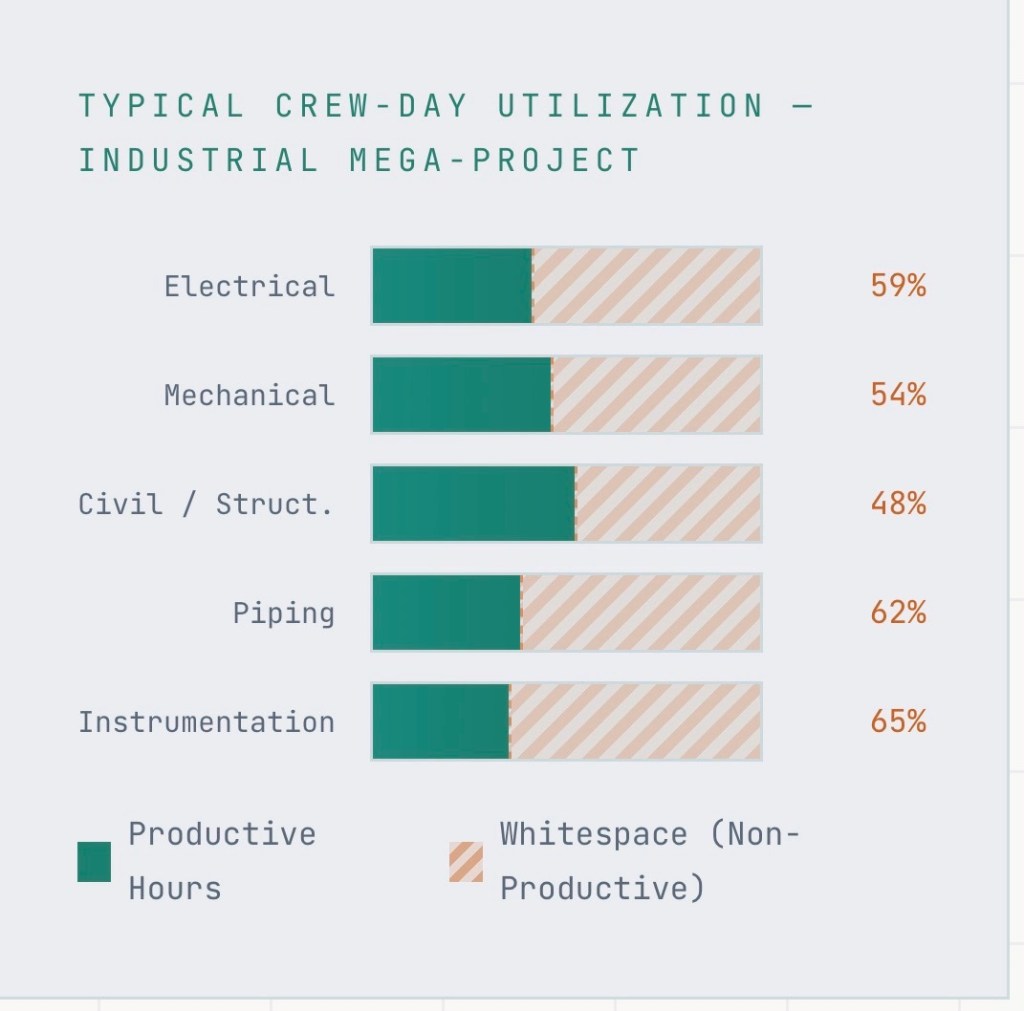
Productive Hours Whitespace (Non-Productive)
Look at that chart. On a typical industrial project, more than half of every crew-day is whitespace. Instrumentation crews, the ones doing the most coordination-dependent work routinely lose two-thirds of their available hours. And yet nobody on the project team has “whitespace” in their job title, their KPIs, or their morning standup agenda.
WHY NOBODY MANAGES IT
This is the part that should genuinely bother you. The Financial opportunity is staggering. A $2 billion mega-project with 55% average whitespace across its labor force is carrying roughly $400–$600 million in non-productive labor cost. Even a modest 15-point improvement in utilization would recover $100M+ without adding a single worker or extending the schedule by a day.
So why isn’t every owner, every EPC, every Construction Management firm obsessing over this?
1. THE CONTRACTING MODEL HIDES IT
Lump-sum contracts push whitespace risk to subcontractors, who bury it in their bids as a cost of doing business. Cost-plus contracts push it to owners, who see labor hours billed but have
no mechanism to distinguish productive hours from whitespace. Neither model creates a feedback loop. Neither model creates accountability. The cost is real but the line item doesn’t exist.
2. THE TOOLS AREN’T BUILT FOR IT
Primavera tracks activities. Procore tracks documents. Nothing in the standard construction tech stack tracks the gap between activities at the crew level. Earned value tells you whether you’ve done the work you planned. It tells you absolutely nothing about whether the labor you mobilized was doing that work — or standing in a parking lot waiting for it.
3. NOBODY OWNS IT ORGANIZATIONALLY
The project manager owns the schedule. The superintendent owns the field. The contracts manager owns the subcontracts. Whitespace lives in the seams between all three and in construction’s rigidly siloed org charts, seams are where accountability goes to die. Managing whitespace requires a cross-functional view that most project organizations are structurally incapable of producing.
4. THE INDUSTRY CONFUSES ACTIVITY WITH PRODUCTIVITY
This is the deepest problem. Construction culture equates presence with progress. If workers are on-site, if cranes are swinging, if material is moving the project “feels” productive. Nobody wants to be the person who says “yes, we have 2,000 workers on site, and 1,100 of them aren’t producing value right now.” That conversation requires a kind of honesty the industry hasn’t developed the appetite for.
THE GLOBAL WHITESPACE COST A CONSERVATIVE ESTIMATE
$1.6 Trillion / Year
Global construction output ≈ $13.5T annually.
Labor typically represents 40–50% of project cost ≈ $5.4T–$6.7T.
Average whitespace across all project types ≈ 30–45%. Conservative mid-range whitespace cost: $1.6T+ in nonproductive labor spend, every year, worldwide.
Read that number again. $1.6 trillion. That’s not a rounding error. That’s larger than the GDP of Australia. It’s the single biggest efficiency failure in the global economy, and it doesn’t have a Wikipedia page.
WHY THE GLOBAL COMMUNITY HASN’T ADOPTED IT
The honest answer is uncomfortable: managing whitespace requires the industry to admit that its current model of work execution is fundamentally broken.
That’s a hard sell. The construction industry is one of the most conservative on Earth — not politically, but operationally. Methods that were standard in 1985 are still standard today. The apprenticeship model, the trade jurisdictions, the paper-based turnover processes, the contractual structures all of it is load-bearing. Changing any one piece threatens the others.
Whitespace management isn’t a plugin. You can’t bolt it onto an existing project and hope for results. It requires rethinking how work is sequenced at the constraint level, how trades are mobilized against work-face readiness instead of contractual dates, how shared resources are allocated dynamically instead of by seniority or loudest-foreman-wins. It requires real-time data infrastructure that most job sites still don’t have. And it requires someone; a person, a team, a function whose entire job is to see the gaps between the work and close them.
The industry has avoided this because it’s systemic surgery, not cosmetic. And in a sector that operates on thin margins with enormous liability exposure, systemic surgery feels like a risk nobody wants to own.
THE FINANCIAL OPPORTUNITY IS OBSCENE
But here’s the thing about avoiding systemic surgery: the patient is still bleeding.
Every mega-project that runs over budget is, at some non-trivial percentage, paying for whitespace it never quantified. Every owner who wonders why their $500M project came in at $720M is looking at the wrong line items. The overrun isn’t in steel prices or change orders or at least, it’s not only there. It’s in the 1,200 crew-days of dead time that never appeared in a single report because no one was measuring it.
The firm that figure this out First will have an advantage that’s almost unfair. A contractor who can demonstrate 15–20% better crew utilization than their competitors can bid lower, deliver faster, and still make higher margins. An owner who demands whitespace metrics from their delivery partners will see genuine cost performance instead of the Fiction that lives in most monthly progress reports.
This isn’t theoretical. The data exists. The math works. The tools to measure and manage whitespace can be built with technology that already exists , time-and-motion capture, constraint-based scheduling, real-time resource allocation, crew-level utilization dashboards. The only thing missing is the decision to treat whitespace as what it is: the largest controllable cost on every project, hiding in plain sight.
The global construction industry doesn’t have a labor shortage problem. It has a labor utilization problem. We don’t need more workers. We need to stop wasting half the ones we already have.
WHERE THIS GOES
The projects that will define the next decade data centres, energy transition infrastructure, semiconductor fabs, nuclear new-build cannot afford the whitespace tax that prior generations tolerated. The capital intensity is too high. The timelines are too compressed. The skilled labor pool is too thin to absorb the waste.
Someone is going to crack this. Some owner is going to mandate whitespace reporting as a contract requirement. Some contractor is going to build a utilization-first delivery model and start winning every bid they enter. Some consulting firm is going to walk into a boardroom, show the board what their whitespace is actually costing them, and change the conversation permanently.
The question isn’t whether whitespace management becomes a discipline. It’s whether you’re the one who brings it — or the one who keeps pretending the gap doesn’t exist while your competitors close it.
FIND YOUR WHITESPACE
Construction Resource Utilization Consulting delivers crew-level utilization audits that quantify your whitespace and build the roadmap to close it.LEARN MORE
© 2026 Construction Resource Utilization Consulting | constructionresourceutilization.com
 Resource Management